Del Mar Photonics - Del Mar Photonics product brochures
Del Mar Photonics sponsors APS focus session "Photophysics of Cold Molecules"
Del Mar Photonics sponsors
Best talk contest
at American Physical Society focus Session "Photophysics of Cold Molecules"
during APS 2008 annual meeting.
In order to facilitate participation of young scientists we have organized a
contest for the best talk given by a student or a post-doc. The winner was
chosen by a committee (Massimi Boninsegni, Dave DeMille, Takamasa Momose, Jun
Ye) and was given a certificate on the last day of the focus session.
Del Mar Photonics and IoP J. Phys. B awarded both best student and post-doc
presenters with a $500 prize.
The winners are Stephen Hogan and Kirill Kuyanov-Prozument - our
congratulations!
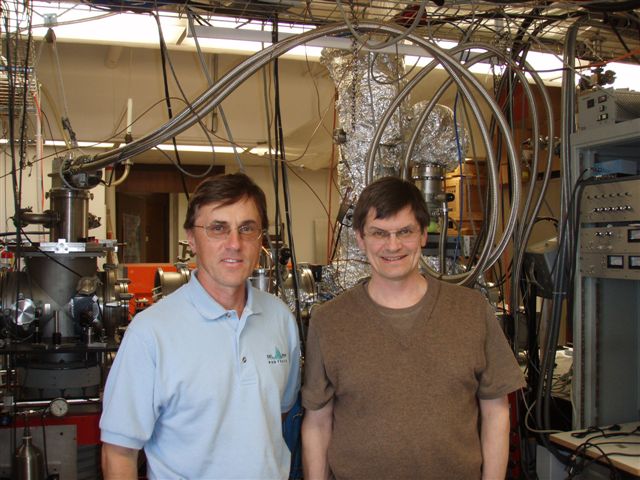
Sergey Egorov, President & CEO of Del Mar Photonics, Inc., and Andrey Vilesov, Chair of the American Physical Society focus session "Photophysics of Cold Molecules", in the University of Southern California
Award announcement before APS meeting:
Dear Contributors to the APS focus session "Photophysics Cold Molecules",

we are proud to announce that we will be able to award the two best
contributions by young researchers with a prize, consisting of a
plaque/certificate and $500,-. The jury will consist of several of the
invited speakers of the session.

All students and postdocs who have received their Ph.D. (or
equivalent) within the last five years (i.e., after March 10, 2003)
are eligible to participate in the contest. If you are within this
group of contributors and will present the work yourself, please send
us an email confirming your status. This way we can prepare a list of
participating presentations for the jury.

These prizes are made possible by the generous support of Del Mar
Photonics (http://www.dmphotonics.com) and J. Phys. B (http://www.iop.org/journals/jphysb). Award Certificate

We are looking forward to see you all in new Orleans.

Best wishes,
Jochen and Andrey
--

Jochen Küpper
Fritz-Haber-Institut der MPG -- Department of Molecular Physics
Faradayweg 4-6
D-14195 Berlin, Germany

phone:   +49-30-84135686
fax:     +49-30-84135892


Andrey Vilesov
Department of Chemistry
University of Southern California
Los Angeles, CA 90089-0482
phone:   +1-213-8212936
Related Del Mar Photonics products
Femtosecond Lasers
Trestles femtosecond Ti:Sapphire laser
Trestles Finesse femtosecond
Ti:Sapphire laser with integrated DPSS pump laser
Teahupoo Rider femtosecond amplified
Ti:Sapphire laser
Mavericks femtosecond
Cr:Forsterite laser
Tamarack femtosecond fiber laser (Er-doped
fiber)
Buccaneer femtosecond OA fiber laser (Er-doped
fiber) and SHG
Cannon Ultra-broadband light source
Tourmaline femtosecond Yt-doped fiber laser
CW single-frequency ring Ti:Sapphire and dye lasers
Tekhnoscan introductory brochure
Flagship
model of 15-kHz-linewidth CW Ti:Sapphire laser TIS-SF-777
CW single-frequency ring Ti:Sapphire laser model TIS-SF-07
Frequency-stabilized CW single-frequescy ring Dye laser DYE-SF-077
Resonant Frequency Doubler for CW single-frequency lasers, model FD-SF-07
Combined CW Ti:Sapphire/Dye laser with intracavity frequency doubling, model
TIS/DYE-FD-08
Combined CW single-frequency laser
system based on Ti:Sapphire and Dye laser TIS/DYE-SF-07
Sponsoring Units: DCP
Chair: Andrey Vilesov, University of Southern California
Morial Convention Center - 218
| Monday, March 10, 2008 8:00AM - 8:36AM |
A26.00001:
Isolation of Molecules in Helium Nanodroplets: Spectroscopy and Dynamics at
Ultra-cold Temperatures - local link Invited Speaker: Frank Stienkemeier The isolation of atoms, molecules, clusters or nano-sized complexes in helium nanodroplets allows detailed spectroscopic studies at temperatures in the millikelvin range. Moreover, femtosecond real-time spectroscopy has been introduced to study dynamical processes in the ultracold helium environment. On the one hand, wave packet propagation opens a window to dynamical processes, allowing even a view to superfluid properties at the nanoscale. This is exemplified at decoherence effects in the wave packet propargation of small molecules attached to the droplets. On the other hand, high-resolution mass spectra using both femtosecond photoionisation (PI) as well as electron impact ionization enable us to characterize reactive processes at temperatures in the millikelvin range. As an example, alkali cluster -- water complexes are formed in helium droplets. By recording multi-photon PI spectra we can distinguish between reactive processes of the neutral clusters and ionic reactions occurring after ionisation of the alkali cluster component. These studies pave the way to time-resolved reaction dynamics at very low temperatures. [Preview Abstract]
|
| Monday, March 10, 2008 8:36AM - 8:48AM |
A26.00002:
Nonequilibrium magnesium complexes formed in helium nanodroplets Josef Tiggesb\"aumker , Andreas Przystawik , Sebastian G\"ode , Karl-Heinz Meiwes-Broer Doping helium droplets with alkaline earth atoms is an interesting tool to investigate the interaction with the superfluid helium. Magnesium is a corner case regarding the degree of solvation in helium [1,2] which may enable the detection of quantized vortices in helium droplets. In this contribution we add another facet to the discussion. The absorption of helium droplets doped with magnesium atoms is measured with resonant two-photon ionization at different combinations of droplet size and the number of doped Mg atoms. This enables the unambiguous identification of the absorption of an isolated atom inside the droplet centered around 279\,nm. When increasing the Mg content of the droplet we find evidence for the formation of metastable, weakly bound Mg complexes. After excitation of such a complex it collapses to a Mg cluster on a timescale of 20\,ps. \newline [1] J. Reho \emph{et al}., J. Chem. Phys. {\bf 112}, 8409 (2000) \newline [2] Y. Ren and V.V. Kresin, Phys. Rev. A {\bf 76}, 043204 (2007) [Preview Abstract]
|
| Monday, March 10, 2008 8:48AM - 9:00AM |
A26.00003:
Superfluid $^4$He density functional theory in 2-D cylindrical coordinates Jussi Eloranta , Sean French , Steven Fiedler Bosonic density functional theory describing superfluid $^4$He is formulated in 2-D cylindrical coordinates and a numerical implementation of the model using a regular spatial grid basis is presented. The 2-D formulation has many important applications as the 1-D treatment cannot, for example, describe translational motion of atoms and molecules solvated in the liquid and the 3-D theory is usually computationally too expensive, especially when describing dynamics in bulk superfluid $^4$He. The theory is implemented in both real and imaginary time forms for allowing solution of both time-dependent and time-independent problems. Two test cases for the developed method are presented and the results are compared against the previously published results. Finally, the method is applied to describe solvation of single wall carbon nanotubes in superfluid $^4$He at 0 K and the implications of the results to dynamic liquid response are discussed. [Preview Abstract]
|
| Monday, March 10, 2008 9:00AM - 9:12AM |
A26.00004:
Photo-induced isomerization and chemical reaction dynamics in superfluid
helium droplets Jeremy Merritt , Gary Douberly , Roger Miller Near threshold photo-induced isomerization and photo-induced chemical reactions have long been sough after as sensitive probes of the underlying potential energy surface. One of the most important questions asked is how the initially bright quantum state couples to the reaction coordinate, and thus relates to energy transfer in general. Helium droplets have now allowed us to stabilize entrance channel clusters behind very small reaction barriers such that vibrational excitation may result in reaction. Through two examples, namely the isomerization of the 2 binary complexes of HF-HCN {\{}Douberly et al. PCCP 2005, 7,463{\}}, and the induced reaction of the gallium-HCN complex {\{}Merritt et al. JPCA 2007, DOI:10.1021/jp074981e{\}} we will show how the branching ratios for reaction and predissociation can determined and the influence of the superfluid He solvent. [Preview Abstract]
|
| Monday, March 10, 2008 9:12AM - 9:24AM |
A26.00005:
Rydberg States of Na-doped Helium Nanodroplets Marcel Drabbels The dynamics of excited states of Na atoms deposited on the surface of helium nanodroplets has been investigated with velocity map ion imaging, photoelectron spectroscopy and time-of-flight mass-spectroscopy. For the first time, the excitation spectra of Na-doped helium nanodroplets corresponding to Rydberg states of Na atoms have been measured from the lowest excited 3p state up to the ionization threshold. All lines in the excitation spectra are shifted and broadened with respect to the corresponding atomic lines. In addition to bare Na* atoms also Na*He$_{N}$ ($N$ = 1-6) exciplexes are detected upon excitation. Photoelectron spectroscopy reveals the desorption of Na* not only in the initially excited states but also in lower lying states, indicating that relaxation plays an important role. The recorded velocity distributions show interesting characteristics: for the lowest states the mean kinetic energy of Na* increases linearly with excitation energy. The velocity distributions of Na*He$_{N}$ exciplexes do not manifest such remarkable properties. The observations can be largely explained by assuming that the interaction of Na* with the helium nanodroplet can be described by the sum of Na*-He pair potentials. [Preview Abstract]
|
| Monday, March 10, 2008 9:24AM - 9:36AM |
A26.00006:
Photoelectron imaging of doped helium nanodroplets Daniel Neumark Photoelectron images of helium nanodroplets doped with Kr and Ne atoms are reported. The images and resulting photoelectron spectra were obtained using tunable synchrotron radiation to ionize the droplets. Droplets were excited at 21.6 eV, corresponding to a strong droplet electronic excitation. The rare gas dopant is then ionized via a Penning excitation transfer process. The electron kinetic energy distributions reflect complex ionization and electron escape dynamics. [Preview Abstract]
|
| Monday, March 10, 2008 9:36AM - 9:48AM |
A26.00007:
High Resolution Fluorescence Excitation and Dispersed Emission Spectra of
Organic Molecules in Superfluid Helium Nanodroplets Alkwin Slenczka , Ricarda Riechers , Dominik Pentlehner , Alexander Vdovin Superfluid helium droplets serve as a very gentle cryogenic matrix for molecular spectroscopy. The low temperature and high thermal conductivity of superfluid helium droplets are of great advantage for the investigation of dispersed emission spectra of molecules. As a complement to the fluorescence excitation spectrum the emission spectra provide important details on dynamic processes of intramolecular as well as intermolecular nature. This will be demonstrated for various examples such as intramolecular proton tunnelling, isomeric van der Waals complexes, tautomerization and microsolvation. [Preview Abstract]
|
| Monday, March 10, 2008 9:48AM - 10:24AM |
A26.00008:
Coherent boson dynamics in strongly localized potentials - helium
excitations at planar aromatic molecules and trapped cold atoms Invited Speaker: K. Birgitta Whaley Planar aromatic molecules provide strongly localizing potentials for helium that considerably modify the local superfluid properties of a solvating helium environment. I shall describe some of the effects of these interactions on the solvation structure and spectroscopy of tetracene and phthalocyanine in helium droplets, comparing results of zero and finite temperature quantum Monte Carlo simulations with experimental data. The helium atoms closest to the molecule are seen to show similarities to trapped cold atoms in multi-well potentials. Studies of cold bosons with attractive and repulsive interactions in double well potentials will also be presented, showing formation of squeezed and quantum superposition states of cold atoms. [Preview Abstract]
|
| Monday, March 10, 2008 10:24AM - 10:36AM |
A26.00009:
Fragmentation dynamics inside helium nanodroplets: new theoretical results Nadine Halberstadt , David Bonhommeau , Marius Lewerenz We present a theoretical study on the effect of a helium nanodroplet environment on the fragmentation dynamics of embedded rare gas cluster ions. The helium atoms are treated explicitly, with zero-point effects taken into account through an effective helium-helium interaction potential. All the nonadiabatic effects between electronic states of the ionized rare gas cluster are taken into account. Our results reveal new mechanisms for the cooling by helium, and show that the dopant can be ejected from the helium droplet. These results will be presented and discussed. [Preview Abstract]
|
| Monday, March 10, 2008 10:36AM - 10:48AM |
A26.00010:
Suppressing the fragmentation of fragile molecules in helium nanodroplets by
co-embedding with water: Possible role of the electric dipole moment Yanfei Ren , Vitaly Kresin When fragile molecules are embedded in liquid helium nanodroplets, electron-impact ionization usually leads to fragmentation which is as extensive as for isolated gas-phase molecules. This occurs because of the energy release accompanying charge transfer from the impurity to the He$^{+}$ hole created by electron bombardment. However, in experiments with glycine, polyglycine peptide chains, and alkane hydrocarbon chains we found that if a few molecules of water are co-embedded with these molecules, the fragmentation of the latter is drastically reduced or completely eliminated. On the other hand, the fragmentation of alkanethiols remains unaffected. On the basis of these observations, it is proposed that the fragmentation ``buffering'' effect may correlate with the magnitude of the impurity's electric dipole moment, which steers the migration of the ionizing He$^{+ }$hole through the droplet. [Preview Abstract]
|
| Monday, March 10, 2008 10:48AM - 11:00AM |
A26.00011:
Path integral investigation of the electronic spectra of He-tetracene
clusters Heather D. Whitley , K. Birgitta Whaley Planar aromatic molecules (PAMs) are nanoscale precursors to bulk graphite. Their electronic spectra have been extensively studied in $^{4}$He nanodroplets and show a number of unusual spectroscopic features. We have conducted many-body quantum simulations of tetracene in He nanodroplets to probe the 1.1 cm$^{-1}$ spectral splitting of the electronic origin seen for this PAM. We calculate spectral shifts and He density profiles via path integral quantum Monte Carlo simulations. The spectral splitting is examined using a path integral correlation function approach to determine the lowest-lying vibrational excitation frequencies for small He$_{N}$-tetracene clusters. Simulations in the S$_{1}$ state of tetracene utilize a semi-empirical perturbative interaction potential for a He atom with a PAM. Results for the splitting of the electronic origin and the spectral shifts are in good agreement with experiment. Prepared by LLNL under Contract DE-AC52-07NA27344. [Preview Abstract] |
Femtosecond Lasers
Trestles femtosecond Ti:Sapphire laser
Trestles Finesse femtosecond
Ti:Sapphire laser with integrated DPSS pump laser
Teahupoo Rider femtosecond amplified
Ti:Sapphire laser
Mavericks femtosecond
Cr:Forsterite laser
Tamarack femtosecond fiber laser (Er-doped
fiber)
Buccaneer femtosecond OA fiber laser (Er-doped
fiber) and SHG
Cannon Ultra-broadband light source
Tourmaline femtosecond Yt-doped fiber laser
CW single-frequency ring Ti:Sapphire and dye lasers
Tekhnoscan introductory brochure
Flagship
model of 15-kHz-linewidth CW Ti:Sapphire laser TIS-SF-777
CW single-frequency ring Ti:Sapphire laser model TIS-SF-07
Frequency-stabilized CW single-frequescy ring Dye laser DYE-SF-077
Resonant Frequency Doubler for CW single-frequency lasers, model FD-SF-07
Combined CW Ti:Sapphire/Dye laser with intracavity frequency doubling, model
TIS/DYE-FD-08
Combined CW single-frequency laser
system based on Ti:Sapphire and Dye laser TIS/DYE-SF-07
Sponsoring Units: DCP
Chair: Roland Wester, University of Freiburg
Morial Convention Center - 218
| Monday, March 10, 2008 11:15AM - 11:51AM |
B26.00001:
Molecular collision studies with Stark-decelerated beams Invited Speaker: Gerard Meijer Molecular scattering behaviour has generally proven difficult to study at low collision energies. We formed a molecular beam of OH radicals with a narrow velocity distribution and a tunable velocity by passing the beam through a Stark decelerator [1]. The transition probabilities for inelastic scattering of the OH radicals with Xe atoms were measured as a function of the collision energy in the range of 50 to 400 wavenumbers. The behaviour of the cross-sections for inelastic scattering near the energetic thresholds was accurately measured, and excellent agreement was obtained with cross-sections derived from coupled- channel calculations on ab initio computed potential energy surfaces [2]. For collision studies at lower energies, the decelerated beams of molecules can be loaded into a variety of traps. In these traps, electric fields are used to keep the molecules confined in a region of space where they can be studied in complete isolation from the (hot) environment. Typically, 10$^5$ state- selected molecules can be trapped for times up to several seconds at a density of 10$^7$ mol/cm$^3$ and at a temperature of several tens of mK [3]. The long interaction time afforded by the trap has been exploited to measure the infrared radiative lifetime of vibrationally excited OH radicals, for instance, as well as to study the far-infrared optical pumping of these polar molecules due to blackbody radiation [4]. As an alternative to these traps, we have demonstrated an electrostatic storage ring for neutral molecules. In its simplest form, a storage ring is a trap in which the molecules - rather than having a minimum potential energy at a single location in space - have a minimum potential energy on a circle. To fully exploit the possibilities offered by a ring structure, it is imperative that the molecules remain in a bunch as they revolve around the ring. This ensures a high density of stored molecules, moreover, this makes it possible to inject multiple - either co-linear or counter propagating - packets into the ring without affecting the packet(s) already stored. We have recently demonstrated a prototype molecular synchrotron, which will be used as a low-energy collider for neutral molecules in the future [5].\newline [1] H.L. Bethlem, G. Berden, and G. Meijer, Phys. Rev. Lett. 83, (1999) 1558-1561.\newline [2] J.J. Gilijamse, S. Hoekstra, S.Y.T. van de Meerakker, G.C. Groenenboom, and G. Meijer, Science 313, (2006) 1617-1620.\newline [3] S.Y.T. van de Meerakker, P.H.M. Smeets, N. Vanhaecke, R.T. Jongma, and G. Meijer, Phys. Rev. Lett. 94, (2005) Artn. 023004.\newline [4] S. Hoekstra, J.J. Gilijamse, B. Sartakov, N. Vanhaecke, L. Scharfenberg, S.Y.T. van de Meerakker, and G. Meijer, Phys. Rev. Lett. 98, (2007) Artn. 133001.\newline [5] C.E. Heiner, D. Carty, G. Meijer, and H.L. Bethlem, Nature Physics 3, (2007) 115-118. [Preview Abstract]
|
| Monday, March 10, 2008 11:51AM - 12:03PM |
B26.00002:
Magnetoelectrostatic trapping of neutral OH molecules Brian Sawyer , Benjamin Stuhl , Benjamin Lev , Mark Yeo , Dajun Wang , Jun Ye Advances in cold molecule production promise to profoundly impact research on precision measurement, quantum information, and controlled chemistry. To this end, we employ a Stark decelerator to remove 99.5{\%} of the center-of-mass kinetic energy of a supersonic beam of ground-state OH molecules. We subsequently trap a 70 mK sample of the decelerated molecules at a density of $>$10$^{5}$ cm$^{-3}$ within a magnetic quadrupole whose center lies $\sim $1cm from the decelerator exit. Our magnetoelectrostatic trap (MET) design allows for the addition of an electric field of variable magnitude to the trapped sample to facilitate polar-molecule collision studies. We report progress toward observation of cold collisions between samples of polar molecules. [Preview Abstract]
|
| Monday, March 10, 2008 12:03PM - 12:15PM |
B26.00003:
Photodissociation of SO$_2$ as a way to cold atoms and molecules Lisdat Christian , Oleg Bucicov , Marcin Nowak , Sebastian Jung , Eberhard Tiemann We discuss the possibility to use the photodissociation of cold SO$_2$ molecules to produce internally and translationally cold photofragments SO and O. It is expected from our measurements of the molecular Stark effect~[1] that the dissociation pathways and excess energies of the fragments are tunable by electric fields~[2]. Cold SO$_2$ molecules are produced by Stark deceleration. We have realized a Stark decelerator that is able to slow down packages SO$_2$ in weak-field seeking levels to a few 10~m/s center of mass velocity. A Stark decelerator with 326~stages is required for this purpose, since the ratio of Stark shift to initial kinetic energy is small for SO$_2$. The photofragments SO and O have triplet ground states, while the ground state of SO$_2$ is diamagnetic. In combination with the photodissociation at the threshold we want to employ this constellation to accumulate fragments in a magnetic trap by dissociating SO$_2$ as it is stopped by electric fields in the center of the trap. \newline [1] J. Phys. B \textbf{39}, S1085 (2006). \newline [2] Phys. Rev.~A \textbf{74}, 040701(R) (2006). [Preview Abstract]
|
| Monday, March 10, 2008 12:15PM - 12:27PM |
B26.00004:
Alternating gradient focusing and deceleration of large molecules Kirstin Wohlfart , Fabian Gr\"atz , Frank Filsinger , Gerard Meijer , Jochen K\"upper During the last decade, fascinating progress has been made in the spectroscopy of the ``molecular building blocks of life''. Meanwhile, our group has been developing methods to decelerate neutral, polar molecules using time varying inhomogeneous electric fields. Extending these techniques to bio-molecules would allow, for instance, to increase observation times for precision spectroscopy or to separate different conformers. However, for such large molecules all states are practically high-field seeking. Therefore, alternating gradient focusing has to be applied. Here, we demonstrate the focusing and deceleration of benzonitrile (C$_7$H$_5$N) from a molecular beam. Benzonitrile is prototypical for large asymmetric top molecules that exhibits rich rotational structure and a high density of states. It is decelerated in its absolute ground state from 320~m/s to 289~m/s, and similar velocity changes are obtained for excited rotational states. We are setting up a longer alternating gradient decelerator, which will enable us to decelerate benzonitrile or larger molecules to much lower velocities and to thereby completely separate the decelerated packet from the rest of the beam pulse. [Preview Abstract]
|
| Monday, March 10, 2008 12:27PM - 1:03PM |
B26.00005:
Production and Trapping of Ultracold Polar RbCs Molecules Invited Speaker: David DeMille Our group has recently demonstrated the ability to assemble ultracold, polar molecules from laser-cooled atoms. We use photoassociation followed by stimulated emission pumping to produce RbCs molecules in their absolute ground state, at temperatures $T\sim 100\mu \mbox{K}$. In recent work, we have moved towards the goal of accumulated large, high-density samples of ultracold RbCs. Here we present new results on the trapping and collisional properties of RbCs in levels of high vibrational excitation. [Preview Abstract]
|
| Monday, March 10, 2008 1:03PM - 1:15PM |
B26.00006:
Multistage Zeeman deceleration of hydrogen S.D. Hogan , A. Wiederkehr , M. Andrist , H. Schmutz , B. Lambillotte , F. Merkt With the goals of: (i) performing ultra-high resolution spectroscopy with long interaction times between a cloud of cold atoms or molecules and a narrow bandwidth radiation field, and (ii) studying cold reactive collisions in which the kinetic energies and quantum states of the colliding particles may be controlled to a high degree, a multi-stage Zeeman decelerator for neutral radicals has recently been developed in our laboratory. This instrument relies on the same concept of phase stability employed in charged particle accelerators. It opens up the possibility to manipulate the translational motion of a wider range of species than has been demonstrated using other quantum-state-selective techniques such as multi-stage Stark deceleration, and applies to a very different class of species than those to which Rydberg Stark deceleration is appropriate. The results of a recent series of experiments in which we have decelerated ground state hydrogen will be presented along with progress toward three-dimensional magnetic trapping of the decelerated radicals. In these experiments magnetic fields of 1-2~T are pulsed in each of the coils which make up the decelerator for tens of microseconds, with rise and fall times shorter than 5~$\mu$s. We have characterized the decelerated part of the gas pulse and studied the effect of zero field time windows, in which electron spin flips can occur, on the deceleration process. [Preview Abstract]
|
| Monday, March 10, 2008 1:15PM - 1:27PM |
B26.00007:
Kinetics of Cold Molecule Production in ``Kinematic'' Cooling Jeffrey Kay , Kevin Strecker , David Chandler ``Kinematic'' cooling is a general technique by which a vast array of molecules can be translationally cooled using crossed atomic and molecular beams. The success of the technique relies primarily on the existence of an approximate mass degeneracy between the molecule to be cooled and its atomic (or molecular) collision partner. Here, we discuss factors that affect the efficiency of cold molecule production by this method, as well as schemes that may allow tunability of the velocity and temperature of the cold molecules on a fine scale. [Preview Abstract]
|
| Monday, March 10, 2008 1:27PM - 1:39PM |
B26.00008: A
new source for quantum optics with biomolecules and biomolecular clusters Markus Marksteiner , Philipp Haslinger , Hendrik Ulbricht , Markus Arndt We present recent progress towards matter wave experiments with amino acids, polypeptides and large biomolecular clusters. All successful experiments on macromolecule interferometry so far, with fullerenes, fullerene derivates and large perfluoroalkyl-functionalized azobenzenes used effusive beam sources. The combination of Stark deflectometry with quantum interferometry also allowed us to create a new device for precisely measuring electric susceptibilities of large molecules in the gas phase. In order to apply quantum interference to molecules of biological interest, we have now implemented a pulsed laser desorption source. The combination of UV laser desorption into an intense noble gas jet and single-photon ionization by a VUV excimer laser (157nm) allows us to observe intense neutral jets of amino acids (e.g. Tryptophan), nucleotides (e.g. Guanin) and polypeptides ranging from tri-peptides to Gramicidin. Remarkably, we also found a new method for producing large neutral amino acid clusters, such as for instance Trp$_{30}$, with masses exceeding 6000 amu: the addition of alkaline Earth salts in the desorption process leads to the inclusion of at least one metal atom per complex and is sufficient to catalyze the cluster formation process. [Preview Abstract]
|
| Monday, March 10, 2008 1:39PM - 2:15PM |
B26.00009:
Collisions of ultracold molecules Invited Speaker: Hanns-Christoph Naegerl In our experiments we routinely produce ultracold trapped samples of dimer molecules out of a Cs atomic gas by exploiting the atom-dimer coupling near Feshbach resonances. We explore the rich molecular structure for the Cs dimers near the atomic threshold by consecutive state transfer after initial dimer production and produce atom-dimer mixtures for which we measure the atom-dimer collisional rate as a function of magnetic field at temperatures down to 40 nK. We find resonant enhancement of this rate for sufficiently small dimer binding energies for which coupling to an Efimov trimer state is possible. We also produce pure dimer samples for which we measure the collisional loss rate. For a weakly bound molecular s-state this rate depends strongly on temperature and on the applied magnetic field. We will also discuss first results from our experiment on producing ultracold ro-vibrational ground state molecules for the case of Cs dimers and RbCs starting from weakly bound molecules which initially are produced on a Feshbach resonance. [Preview Abstract] |
Femtosecond Lasers
Trestles femtosecond Ti:Sapphire laser
Trestles Finesse femtosecond
Ti:Sapphire laser with integrated DPSS pump laser
Teahupoo Rider femtosecond amplified
Ti:Sapphire laser
Mavericks femtosecond
Cr:Forsterite laser
Tamarack femtosecond fiber laser (Er-doped
fiber)
Buccaneer femtosecond OA fiber laser (Er-doped
fiber) and SHG
Cannon Ultra-broadband light source
Tourmaline femtosecond Yt-doped fiber laser
CW single-frequency ring Ti:Sapphire and dye lasers
Tekhnoscan introductory brochure
Flagship
model of 15-kHz-linewidth CW Ti:Sapphire laser TIS-SF-777
CW single-frequency ring Ti:Sapphire laser model TIS-SF-07
Frequency-stabilized CW single-frequescy ring Dye laser DYE-SF-077
Resonant Frequency Doubler for CW single-frequency lasers, model FD-SF-07
Combined CW Ti:Sapphire/Dye laser with intracavity frequency doubling, model
TIS/DYE-FD-08
Combined CW single-frequency laser
system based on Ti:Sapphire and Dye laser TIS/DYE-SF-07
Sponsoring Units: DCP
Chair: Wolfgang Jaeger, University of Alberta
Morial Convention Center - 218
| Monday, March 10, 2008 2:30PM - 3:06PM |
D26.00001:
Spectroscopy of large hydrogen clusters in He droplets and H$_{2}$ droplets. Invited Speaker: Takamasa Momose Clusters of molecular hydrogen (H$_{2}$) at low temperatures have been attracted much attention because of the possible superfluid phase of molecular hydrogen. Parahydrogen has been predicted to undergo Bose-Einstein condensate (BEC) and to exhibit a superfluid phase below 6 K. However, since the freezing point of H$_{2}$ (14 K) is much higher than the predicted superfluid transltion temperature, the supercooling of bulk H$_{2}$ system has not been achieved despite many attempts. Clusters are known to exhibit lower freezing and melting temperatures than their bulk system due to the size effect. In addition, the melting temperature may become significantly lower than the freezing temperature in such clusters, and coexistence of liquid and solid phases between the melting and freezing temperatures has been predicted theoretically. Thus, clusters of molecular hydrogen are very appealing system for the observation of possible superfluid phase of molecular hydrogen. Since superfluid is a macroscopic property, we have studied properties of hydrogen clusters with fairly large size ($N=100 - 10^{6}$) by using He droplet spectroscopy. Some advantages of using droplet spectroscopy for this study include (1) cluster size can be precisely controlled by its pickup process, and (2) the temperature of clusters is well defined. Laser induced fluorescence of several molecules doped in H$_{2}$ clusters showed clear evidence of non-rigidity of hydrogen clusters at 0.4 K or 4 K. We have also observed a clear difference in the LIF spectra between {\it parahydrogen} and {\it orthohydrogen} clusters. We will discuss the properties of large parahydrogen clusters from the dependence on the cluster size and concentration of orthohydrogen. [Preview Abstract]
|
| Monday, March 10, 2008 3:06PM - 3:18PM |
D26.00002:
Hydrogen clusters that remained fluid Kirill Kuyanov-Prozument , Andrey Vilesov \textit{Para}-H$_{2}$ may constitute the only other superfluid besides helium. The superfluid transition temperature is predicted to be around 2 K, well below freezing of H$_{2}$ at 13.8 K. Numerous attempts to supercool macroscopic H$_{2}$ samples proved to be unsuccessful. Our approach includes formation of H$_{2}$ clusters in a pulsed cryogenic nozzle beam expansion of a neat $p$H$_{2}$ gas as well as \textbf{\textit{X}}\textbf{{\%}} of $p$H$_{2}$ diluted in He and interrogation via Coherent Anti-Stokes Raman Scattering. At \textbf{\textit{X}}\textbf{ = 2 -- 100 {\%}} the frequency of the vibrational Q$_{1}$(0) line in clusters remains constant at about $\nu $ = 4149.7 cm$^{-1}$ very similar to 4149.6 cm$^{-1}$ as in solid $p$H$_{2}$ and lower than in liquid $p$H$_{2 }$at 18 K (4151.9 cm$^{-1})$. The rotational S$_{0}$(0) transition show some characteristic crystal field splitting having magnitude of about 6 cm$^{-1}$. The splitting pattern is different from that in the \textit{hcp} solid, suggesting different structure in solid $p$H$_{2}$ clusters. At \textbf{\textit{X}}\textbf{ $\le $ 2 {\%}}, the frequency of the Q$_{1}$(0) line increases to about 4150.5 cm$^{-1}$, which is consistent with that expected in the supercooled liquid. The S$_{0}$(0) transition in these clusters, consisting of about 5 x 10$^{4}$ molecules, appears as a single line at the same frequency as in liquid $p$H$_{2}$. The temperature of these supercooled clusters is estimated to be less than about 1 K. Possible superfluidity of the clusters is discussed. [Preview Abstract]
|
| Monday, March 10, 2008 3:18PM - 3:30PM |
D26.00003:
Three-body interactions in liquid and solid hydrogen: Evidence from
vibrational spectroscopy Robert Hinde In the cryogenic low-density liquid and solid phases of H$_2$ and D$_2$, the H$_2$ and D$_2$ molecules retain good rotational and vibrational quantum numbers that characterize their internal degrees of freedom. High-resolution infrared and Raman spectroscopic experiments provide extremely sensitive probes of these degrees of freedom. We present here fully-first-principles calculations of the infrared and Raman spectra of liquid and solid H$_2$ and D$_2$, calculations that employ a high-quality six-dimensional coupled-cluster H$_2$-H$_2$ potential energy surface and quantum Monte Carlo treatments of the single-molecule translational degrees of freedom. The computed spectra agree very well with experimental results once we include three-body interactions among the molecules, interactions which we also compute using coupled-cluster quantum chemical methods. We predict the vibrational spectra of liquid and solid H$_2$ at several temperatures and densities to provide a framework for interpreting recent experiments designed to search for superfluid behavior in small H$_2$ droplets. We also present preliminary calculations of the spectra of mixed H$_2$/D$_2$ solids that show how positional disorder affects the spectral line shapes in these systems. [Preview Abstract]
|
| Monday, March 10, 2008 3:30PM - 3:42PM |
D26.00004:
Rotational spectrum of small, doped $^{3}$He clusters Tatjana Skrbic , Saverio Moroni , Stefano Baroni In recent years, symmetry-adapted imaginary-time correlation functions have been extensively used to study the rotational spectrum of doped $^{4}$He clusters within the frame of the reptation quantum Monte Carlo method. The success of this approach relies on the choice of suitable correlation functions, whose spectral resolution is dominated by few, well separated eigenvalues of the Hamiltonian. Under these conditions, reliable excitation energies can be extracted by inverse Laplace transform. This method has been tailored for bosons, due to the positivity of the ground-state wave-function and to the distinctive scarcity of low-lying states. For sufficiently small systems, however, the states of the discrete spectrum can be calculated in the same manner also with Fermi statistics, using appropriate generalizations of the correlation functions. We present rotational spectra for small $^{3}$He clusters doped with molecules --such as CO2 and OCS-- whose effective moments of inertia, in $^{4}$He clusters, feature a non-trivial dependence on the system size, with a pronounced turnaround for less than 10 atoms. [Preview Abstract]
|
| Monday, March 10, 2008 3:42PM - 4:18PM |
D26.00005:
Quantum melting and superfluidity of molecular hydrogen clusters Invited Speaker: Massimo Boninsegni Clusters of parahydroge comprising between 10 and 50 molecules have been extensively studied by computer simulations based on the continuous-space Worm Algorithm, which allows one to go down to temperatures as low as a few hundredths of a K. These clusters display an intriguing interplay of liquid- and solid-like behavior as a function of both temperature and cluster size. In this sense, their physics is far richer than that of helium clusters. An intriguing phenomenon predicted by our simulations is {\it quantum melting}, whereby clusters in some size range (roughly between 22 and 30 molecules) are observed to go from rigid, solid-like, to essentially structureless and liquid-like as the temperature is lowered, due to the onset of quantum exchange cycles involving all the molecules in the cluster. At low temperature these clusters turn superfluid; their local superfluid response has been analyzed, and found to be essentially uniform throughout the system in the $T\to 0$ limit, even in clusters with a pronounced shell structure. In particular, exchanges involving molecules in the inner and outer shells are shown to be underlying the superfluid response. This system can also allow one to gain insight into the relationship of the superfluid properties with Bose condensation, and aspect that has been thoroughly investigated. [Preview Abstract]
|
| Monday, March 10, 2008 4:18PM - 4:30PM |
D26.00006:
Alkaline Earth Metal Atom Complexes with HCN Trapped On/In Helium Droplets:
Vibrational Excitation Induced Solvation and Desolvation Gary Douberly Infrared laser spectroscopy is used to probe the rotational dynamics of the binary HCN-M (M=Ca, Sr) complexes, either solvated within or bound to helium droplets. The ``surface bound'' spectral signatures reported previously for the HCN-alkali atom complexes are observed for both species, while a second band is observed for HCN-Ca that corresponds to a solvated species. IR-IR double resonance spectroscopy is used to probe the interconversion of the two distinct HCN-Ca populations. Above a threshold droplet size, vibrational excitation results in the solvation of the surface bound HCN-Sr complex. [Preview Abstract]
|
| Monday, March 10, 2008 4:30PM - 4:42PM |
D26.00007:
Imaging Photoelectron Dynamics in Doped Helium Droplets Chia Wang , Oleg Kornilov , Darcy Peterka , Jeong Kim , Oliver Gessner , Daniel Neumark Photoionization of He droplets doped with Xe and Kr atoms have been investigated by photoelectron imaging utilizing VUV synchrotron radiation. Photoelectron images were recorded over a wide range of He droplet sizes, photon energies, and dopant pick-up conditions. Significant ionization of dopants was observed at 21.6 eV, the absorption maximum of 2${ }^1P$electronic excited state of He droplets, suggesting an indirect ionization via excitation transfer. Photoelectron images and spectra indicate multiple pathways for photoelectrons generated by this process to escape the droplet. Special attention is paid to the excitation transfer dynamics and the electron relaxation in He droplets. It is found that excitation transfer from 2${ }^1P$state to dopants competes with relaxation to the lower 2${ }^1S$ state. The excitation is likely a localized exciton that transfers the energy to the dopant via a dipole-dipole hopping mechanism. The conduction band of He droplets as a function of droplet size is also observed. The conduction band edge reaches the bulk limit for the largest He droplets. The electron under the conduction band becomes trapped and forms an electron bubble that escapes the droplet by transcending a barrier near the liquid/vapor interface. [Preview Abstract]
|
| Monday, March 10, 2008 4:42PM - 4:54PM |
D26.00008:
Interchange-Tunneling Splitting in HCl Dimer in Helium Nanodroplets Dmitry Skvortsov , Russell Sliter , Myong Yong Choi , Andrey F. Vilesov Infrared spectra of HCl dimers have been obtained in helium nanodroplets. The splitting in the vibrationally excited state of the bonded H-Cl stretching band ($v_{2})$ in (H$^{35}$Cl - H$^{37}$Cl) dimers was obtained to be 2.7 cm$^{-1}$ as compared to 3.7 cm$^{-1}$ in free dimer. From the splitting, the strength of the interchange-tunneling interaction in liquid helium was obtained to be 0.85 cm$^{-1}$, which is about a factor of two smaller than in the free dimer. The results are compared with the previous spectroscopic study of (HF)$_{2}$ in He droplets as well as to the theoretical study of (HF)$_{2}$ and (HCl)$_{2}$ dimers in small He clusters. [Preview Abstract]
|
| Monday, March 10, 2008 4:54PM - 5:06PM |
D26.00009:
Path integral studies of methane rotations in $^4$He clusters Nikolay Markovskiy , Chi Mak Path integral simulations have been carried out to study the rotations of a methane inside a single shell of $^4$He atoms at 0.3~K to address the question of whether dopant molecule rotations can be used to probe the quantum statistics and superfluidity of the shell. We examined the effects of the probe molecule on the $^4$He exchanges and their counter effects on the renormalized rotation constant of the probe systematically by varying the intrinsic moment of inertia of the methane. The observed effects show strong dependence on the intrinsic moment of inertia of the rotating probe, with a heavy probe favoring stronger templating of the $^4$He density and a corresponding suppression of exchanges in the shell, as well as a large renormalization in the probe's effective rotation constant, while a light probe shows almost no effect on the shell density or the effective rotation constant. These results can be rationalized in terms of a rotational smearing effect and suggest that there is no clearly quantifiable relationship between the superfluid fraction of the shell and the renormalized rotation constant of the probe for cases where the probe molecule has weak anisotropic interactions with the $^4$He atoms. [Preview Abstract]
|
| Monday, March 10, 2008 5:06PM - 5:18PM |
D26.00010:
Pump-probe spectroscopy of Rg-Br$_2$ linear isomers Jordan Pio , Craig Bieler , Wytze van der Veer , Kenneth Janda We have recorded and analyzed the \mbox{\textit{X}$\rightarrow$\textit{B}} spectra for three Rg--Br-Br linear isomers [Rg = He, Ne, Ar] using pump-probe spectroscopy. This work is an interesting test case for the transition from quantum to quasi-classical dynamics, and how the dynamics are interconnected with changes in the potential energy surface. Helium is not only much lighter than argon, but the He-Br$_2$ potential well is much shallower than that of Ar-Br$_2$. Excitation spectra to individual Rg-Br$_2$ (\textit{B}, $\nu$') intermolecular potentials were recorded by probing the Br$_2$ (\textit{B}, $\nu$') asymptotic limit of the potential while scanning the pump laser. The continuum spectra of the three species are very different, with the He-Br$_2$ spectrum peaking at threshold while the Ar-Br$_2$ spectrum is negligible at threshold and strongly blue shifted. The linear Ne-Br$_2$ bond energy was measured to be \mbox{71 $\pm$ 3 cm$^{-1}$} by the threshold energy for the onset of the continuum. Since excitation tends to move electron density to the $\sigma^*$ orbital of the Br-Br bond near the rare gas atom, the intramolecular stretching vibration (Br-Br) and the intermolecular stretching vibration (Rg-Br) are strongly coupled. The experiments will be compared to a two dimensional model using the best available potential energy functions. [Preview Abstract]
|
| Monday, March 10, 2008 5:18PM - 5:30PM |
D26.00011:
Time-resolved photoionization of He droplets using high-harmonic Oleg Kornilov , Oliver Gessner , Mathew Leonard , Stephen Leone , Daniel Neumark , Chun-Te Peng , Chia Wang Helium droplets are widely used as nanocontainers for matrix-isolated rotational, vibrational and electronic spectroscopy. Their superfluid nature and low temperatures (0.37K) provide gentle environment for embedded atoms, molecules and complexes. However, most of the traditional spectroscopic techniques are not efficient for pure droplets, because of the very high energies of electronic transitions. One of the recent studies [1] conducted using synchrotron light demonstrated very interesting phenomena in photoionization of pure He droplets. It has been shown that below the threshold for He atom photoionization essentially zero kinetic energy electrons are emitted independent of the wavelength of the photoionizing radiation. In this contribution a new experiment will be presented utilizing a novel source of VUV radiation based on the high-harmonic generation. In this process femtosecond pulses of radiation are created, which will be used in a VUV-pump/IR-probe scheme to study dynamics of photoionization of He droplets. First results towards the time-dependent photoelectron spectra will be presented. [1] D. Peterka \textit{et al}, Phys. Rev. Lett. \textbf{91}, 043401 (2003) [Preview Abstract] |
Monday–Friday, March 10–14, 2008; New Orleans, Louisiana
| Abernathy, Douglas Oak Ridge National Laboratory |
Session P36.00001 Advances in Neutron Scattering Instrumentation at Oak Ridge National Laboratory Room: Morial Convention Center 228 |
| Adagideli, Inanc Universitaet Regensburg |
Session Q33.00001 Boundaries Between Current Carrying Semiconductors and Metallic Contacts Room: Morial Convention Center 224 |
| Ahn, Charles Yale University Department of Applied Physics |
Session U5.00001 Structural and Electronic Properties of Epitaxial Complex Oxide-Silicon Interfaces Room: Morial Convention Center RO1 |
| Akimitsu, Jun Department of Physics and Mathematics, Aoyama Gakuin University |
Session J1.00005 The p-and d-electron superconductors -Struggle to find higher-$T_{c}$ superconductors Room: Morial Convention Center LaLouisiane AB |
| Akundi, Murty Xavier University of Louisiana |
Session U7.00002 Preparing minority undergraduate students for successful science careers. Room: Morial Convention Center RO5 |
| Akundi, Murty Xavier University of Louisiana |
Session V5.00001 Lessons Learnt From Hurricane Katrina. Room: Morial Convention Center RO1 |
| Alben, Silas Georgia Institute of Technology |
Session P6.00005 Optimal flexibility in flapping appendages Room: Morial Convention Center RO4 |
| Allen, Emily Dept. of Materials Engineering, San Jose State University |
Session Q7.00001 The Role of Engineering Design in Materials Science and Engineering Curricula Room: Morial Convention Center RO5 |
| Allen, J.W. University of Michigan |
Session H5.00001 Angle-resolved Photoemission of CeCoIn$_5$: Detailed Comparison to LDA and LDA+DMFT Room: Morial Convention Center RO1 |
| Alloul, Henri LPS - CNRS |
Session Y31.00001 Charge order and anomalous magnetism in the Na cobaltates Room: Morial Convention Center 223 |
| Almaas, Eivind Lawrence Livermore Natl Lab |
Session W40.00001 Metabolism and evolution: A comparative study of reconstructed genome-level metabolic networks Room: Morial Convention Center 232 |
| Alsing, Paul M. Air Force Research Laboratory |
Session P5.00004 Spin-induced non-geodesic motion, Wigner rotation and EPR correlations of massive spin-1/2 particles in a gravitational field Room: Morial Convention Center Exhibit Hall A |
| Altman, Ehud Department of Condensed Matter Physics, Weizmann Institute of Science |
Session A14.00007 Probing non local order parameters in highly correlated Bose insulators Room: Morial Convention Center 205 |
| Amador Kane, Suzanne Physics Department, Haverford College |
Session J5.00002 Faculty Work-Family Issues: Finding the Balance at a Liberal Arts College Room: Morial Convention Center RO1 |
| Ambrosch-Draxl,
Claudia Department of Materials Physics, University of Leoben, Franz-Josef-Stra{\ss}e 18, A-8700 Leoben, Austria |
Session S13.00004 Beller Lectureship Talk: Exploring Exact Exchange for collinear and non-collinear magnetism Room: Morial Convention Center 204 |
| Anderson, Philip Princeton University |
Session A5.00005 Vortex liquid Room: Morial Convention Center RO1 |
| Ando, T. Materials Science Research Laboratory, CRIEPI, Tokyo, Japan |
Session P14.00005 High-speed AFM for Studying Dynamic Biomolecular Processes Room: Morial Convention Center 205 |
| Ando, Y. ISIR, Osaka University |
Session U2.00001 Transport anisotropy as a signature of electron nematicity Room: Morial Convention Center LaLouisiane C |
| Anthamatten, Mitchell University of Rochester |
Session A21.00004 Unique Properties of Reversibly Associating Polymer Networks Room: Morial Convention Center 213 |
| Antonoyiannakis,
Manolis (1) Physical Review Letters (2) Columbia University |
Session S7.00002 A Road Less Traveled: An Editorial Career Room: Morial Convention Center RO5 |
| Aoki, Yuki Rutgers University |
Session A5.00003 Frequency dependence and Hysteretic behavior in Non-Classical Rotational Inertia of Solid $^{4}$He Room: Morial Convention Center RO1 |
| Appelbaum, Ian University of Delaware |
Session P33.00005 Spin Transport in Silicon Room: Morial Convention Center 224 |
| Appenzeller, Joerg School of Electrical and Computer Engineering and Birck Nanotechnology Center, Purdue University, West Lafayette, IN 47906 |
Session S2.00005 One-dimensional semiconductors for low-power electronic applications Room: Morial Convention Center LaLouisiane C |
| Archer, Lynden Cornell University |
Session W4.00005 Nanoparticle Ionic Fluids Room: Morial Convention Center 206 |
| Armitage, N. Peter The Johns Hopkins University |
Session Q4.00001 Survival of superconducting correlations across the two-dimensional superconductor-insulator transition: A finite-frequency study Room: Morial Convention Center 206 |
| Asghari, Mehdi Kotura |
Session B3.00004 Silicon Detectors, Sensors and Ultrafast Interconnect. Room: Morial Convention Center RO2 - RO3 |
| Ashbaugh, Henry S. Tulane University |
Session Q17.00002 Contrasting Nonaqueous against Aqueous Solvation on the Basis of Scaled-Particle Theory Room: Morial Convention Center 209 |
| Aspelmeyer, Markus Austrian Academy of Sciences |
Session X4.00005 Towards experimental optomechanical entanglement between a movable mirror and a cavity field. Room: Morial Convention Center 206 |
| Astumian, Dean University of Maine |
Session L16.00005 Trajectories of a Brownian Motor Room: Morial Convention Center 208 |
| Atwater, Harry Applied Physics, Caltech |
Session V28.00001 Plasmonic Metamaterials and Devices Room: Morial Convention Center 220 |
| Aubry, Serge Laboratoire L\'eon Brillouin, CEA Saclay |
Session D6.00005 A nonadiabatic and nonlinear theory for electron transfer Room: Morial Convention Center RO4 |
| Auslaender, Ophir Stanford University |
Session B1.00002 Observation of spin-charge separation and localization in one-dimensional quantum wires Room: Morial Convention Center LaLouisiane AB |
| Austin, Robert Princeton University |
Session P25.00001 Learning from the Jersey Turnpike: Cell Lysis, Labeling and Washing with Microfluidic Metamaterials Room: Morial Convention Center 217 |
| Avouris, Phaedon IBM T.J. Watson Research Center |
Session A28.00007 Carbon nanotube excited states: the role of the environment Room: Morial Convention Center 220 |
| Bacon, Dave University of Washington |
Session P5.00001 Quantum Computational Complexity in the Presence of Closed Timelike Curves Room: Morial Convention Center RO1 |
| Bagayoko, Diola Southern University and A\&M College |
Session L6.00004 A Mathematical Solution to the Theoretical Band Gap Underestimation: Predictive Calculations of Properties of Semiconductors Room: Morial Convention Center RO4 |
| Baldo, Marc MIT, Department of Electrical Engineering and Computer Science |
Session S2.00004 Nanoelectromechanical switches Room: Morial Convention Center LaLouisiane C |
| Balsara, Nitash University of California Berkeley |
Session V18.00001 Thermodynamics, Structure and Transport in Model Fuel Cell Membranes Room: Morial Convention Center 210 |
| Bao, Zhenan |
Session B22.00004 Organic Field Effect Transistors Based on Micro and Nano-sized Single Crystalline Semiconductors. Room: Morial Convention Center 214 |
| Barabasi,
Albert-Laszlo Northeastern University and Notre Dame University |
Session U39.00001 From network dynamics to human activity and mobility patters Room: Morial Convention Center 231 |
| Baranov, Mikhail Universiteit van Amsterdam |
Session X9.00007 Ultracold dipolar gases -- challenge for Experiments and Theory Room: Morial Convention Center RO7 |
| Barbara, Bernard CNRS, Institut N\'eel, Grenoble |
Session L5.00003 Activated quantum criticality of complex systems Room: Morial Convention Center RO1 |
| Barrett, Jonathan University of Cambridge |
Session L14.00001 General probabilistic theories for quantum foundations and quantum information Room: Morial Convention Center 205 |
| Baruah, Tunna University of Texas at El Paso |
Session D21.00005 DFT study of a carotenoid-porphyrin-C$_{60}$ light-harvesting molecular triad Room: Morial Convention Center 213 |
| Bausch, Andreas Technische Universit\"at M\"unchen |
Session H7.00003 Cytoskeletal mechanics: Structure and Dynamics Room: Morial Convention Center RO5 |
| Baym, Gordon University of Illinois at Urbana-Champaign |
Session L1.00004 Lars Onsager Prize Talk: Stepping through forty years of quantum fluids Room: Morial Convention Center LaLouisiane AB |
| Beck, Matthew J. Physics and Astronomy, Vanderbilt University |
Session D19.00001 Stability and Dynamics of Frenkel Pairs in Silicon Room: Morial Convention Center 211 |
| Beggs, John Indiana University |
Session W7.00003 A continuous phase transition in neocortical slice networks Room: Morial Convention Center RO5 |
| Behnia, Kamran LPEM (CNRS - ESPCI) , Paris |
Session Q4.00003 Observation of the Nernst signal generated by fluctuating Cooper pairs Room: Morial Convention Center 206 |
| Beratan, David Duke University |
Session D6.00001 Theory of Electron Transfer and Transport Pathways in Biomolecules Room: Morial Convention Center RO4 |
| Berezovsky, J. Center for Spintronics and Quantum Computation, University of California, Santa Barbara, CA 93106 |
Session D4.00003 Nondestructive optical probe of coherent single spin dynamics in a quantum dot Room: Morial Convention Center 206 |
| Bernevig, B.A. Princeton University |
Session P2.00001 An Exact SU(2) Symmetry and Persistent Spin Helix in a Spin-Orbit Coupled System Room: Morial Convention Center LaLouisiane C |
| Berry, Michael Princeton University |
Session W7.00001 Representing Information with Correlated Neural Populations Room: Morial Convention Center RO5 |
| Bett, Andreas W. Fraunhofer-Institut fur Solare Energie Systeme |
Session P35.00001 Multijunction solar cells for concentrator systems: prospects and challenges Room: Morial Convention Center 227 |
| Bienenstock, Arthur Stanford University |
Session V34.00002 The APS 2007 Meeting on Gender Equity in Physics Room: Morial Convention Center RO4 |
| Binder, K. Institut f\"ur Physik, Johannes-Gutenberg-Universit\"at Mainz, 55099 Mainz, Germany |
Session H3.00005 The Theta Point Of Long Flexible Polymer Chains: When Does It Exist? Room: Morial Convention Center RO2 - RO3 |
| Birge, Robert University of Connecticut |
Session Y7.00002 Protein-Based Three-Dimensional Memories and Associative Processors Room: Morial Convention Center RO5 |
| Bishop, David Bell Labs, LGS, Alcatel-Lucent |
Session V3.00004 The History of Science and Technology at Bell Labs Room: Morial Convention Center RO2 - RO3 |
| Bjork, Mikael IBM Research Zurich |
Session S2.00003 Nanowire Impact Ionization FETs Room: Morial Convention Center LaLouisiane C |
| Blais, A. Universite de Sherbrooke |
Session D5.00001 Superconducting qubits coupled to resonant cavities Room: Morial Convention Center RO1 |
| Bloch, Immanuel Johannes Gutenberg Universit\"at Mainz |
Session P7.00003 Towards Quantum Magnetism with Ultracold Quantum Gases in Optical Lattices Room: Morial Convention Center RO5 |
| Block, Steven Stanford University |
Session B7.00001 Max Delbruck Biological Physics Prize Talk: The Biophysics of Gene Regulation, Studied One Molecule at a Time Room: Morial Convention Center RO5 |
| Blugel, Stefan Forschungszentrum Julich, Germany |
Session Y32.00001 Homochiral magnetic structures at surfaces Room: Morial Convention Center 225 |
| Blumberg, G. Bell Laboratories, Alcatel-Lucent |
Session A11.00004 MgB$_{2}$: Novel properties due to multibands Room: Morial Convention Center RO9 |
| Boninsegni, Massimo University of Alberta |
Session D26.00005 Quantum melting and superfluidity of molecular hydrogen clusters Room: Morial Convention Center 218 |
| Boudaoud, Arezki LPS ENS |
Session A39.00004 On the statistical physics of folding and crumpling Room: Morial Convention Center 231 |
| Bourianoff, George I. Intel |
Session B35.00001 The Nanoelectronics Research Initiative and Beyond CMOS Research Activities in the US Room: Morial Convention Center 227 |
| Boxer, Steven Stanford University |
Session Y7.00001 Earle K. Plyler Prize Talk: Stark Realities Room: Morial Convention Center RO5 |
| Bracco, Annalisa Georgia Tech |
Session L3.00003 Geostrophic Turbulence and the stability of Ocean models Room: Morial Convention Center RO2 - RO3 |
| Brangwynne, Clifford Max Planck Institute |
Session H7.00005 Force fluctuations and polymerization dynamics of intracellular microtubules Room: Morial Convention Center RO5 |
| Bratkovsky, A.M. Hewlett-Packard Laboratories |
Session A35.00004 Tunable plasmonic nanostructures and nanolenses in optical domain Room: Morial Convention Center 227 |
| Breedveld, Victor Georgia Institute of Technology |
Session Y5.00004 Microrheological studies of solvent-response dynamics of polyelectrolytes Room: Morial Convention Center RO1 |
| Bringa, Eduardo M. Lawrence Livermore National Laboratory |
Session P31.00001 Materials under Extreme Conditions: Ultrahigh Strength under Shock Loading Room: Morial Convention Center 223 |
| Brinkman, Alexander Condensed Matter Physics and Devices Group, MESA+ Institute for Nanotechnology, University of Twente |
Session X3.00002 Magnetic effects at the interface between nonmagnetic oxides Room: Morial Convention Center RO2 - RO3 |
| Britten, Richard Eastern Virginia Medical School |
Session W16.00002 New techniques required to understand the by-stander effect in situ. Room: Morial Convention Center 208 |
| Brochard-Wyart,
Francoise Institut Curie |
Session U3.00005 Polymers in Confined Geometry Room: Morial Convention Center RO2 - RO3 |
| Brodholt, John Dept. of Earth Sciences, UCL |
Session J40.00001 The melting curve of MgSiO3 perovskite from ab initio molecular dynamics using the coexistience method Room: Morial Convention Center 232 |
| Broholm, Collin Department of Physics and Astronomy, Johns Hopkins University, Baltimore, MD 21218 |
Session A27.00011 Neutron Scattering from Magnetically Frustrated Ruthenium Pyrochlores Room: Morial Convention Center 219 |
| Brooks, Harold National Severe Storms Laboratory |
Session H6.00002 Tornadoes and Severe Thunderstorms: Physical Understanding and Climate Questions Room: Morial Convention Center RO4 |
| Broun, David Simon Fraser University |
Session S6.00002 Superfluid density in the underdoped cuprates Room: Morial Convention Center RO4 |
| Brown, Craig NIST Center for Neutron Research |
Session S36.00001 Enhancing the interaction strength and capacities of hydrogen storage via surface adsorption Room: Morial Convention Center 228 |
| Brown, Hugh University of Wollongong |
Session U3.00003 Adhesion Room: Morial Convention Center RO2 - RO3 |
| Bruinsma, Robijn Dept. of Physics and Astronomy, UCLA |
Session Q2.00004 Self-Assembly of the HIV Virus Room: Morial Convention Center LaLouisiane C |
| Bryant, Zev Stanford University Schools of Medicine and Engineering |
Session V19.00001 Mechanochemistry of Molecular Motors Room: Morial Convention Center 211 |
| Bucher, Jean-Pierre Universit\'e Louis Pasteur, Institut de Physique et Chimie des Mat\'eriaux de Strasbourg |
Session H21.00001 Probing electronic and magnetic properties of atomic and molecular clusters with sharp tips Room: Morial Convention Center 213 |
| Bulaevskii, Lev Los Alamos National Laboratory |
Session X5.00003 Radiation Due to Josephson Oscillations in Layered Superconductors. Room: Morial Convention Center RO1 |
| Burch, Kenneth Los Alamos National Laboratory |
Session B2.00001 Optical Properties of III-Mn-V Ferromagnetic Semiconductors Room: Morial Convention Center LaLouisiane C |
| Burkard, Guido RWTH Aachen University, Germany |
Session D4.00002 Universal Quantum Gates for Two- and Three-Spin Qubits in Coupled Quantum Dots Room: Morial Convention Center 206 |
| Buyers, Bill National Research Council, Chalk River |
Session U2.00005 Spins in cuprates near the edge of the superconducting phase - incoherent pairing, fluctuations on all timescales and observation of pseudogap energies. Room: Morial Convention Center LaLouisiane C |
| Callaghan, Paul Victoria University of Wellington |
Session X8.00001 Rheo-NMR of shear banded flow in wormlike micelles Room: Morial Convention Center RO6 |
| Campas, Otger Harvard University |
Session A7.00005 Chromosome oscillations in mitosis Room: Morial Convention Center RO5 |
| Campuzano, J.C. University of Illinois at Chicago, Chicago, IL 60607 |
Session S4.00002 Room: Morial Convention Center 206 |
| Carlsson, Anders Washington University in St. Louis |
Session P16.00001 Actin Disassembly Mediated by Severing, Debranching, and Hydrolysis Room: Morial Convention Center 208 |
| Castleman, A. Pennsylvania State University |
Session D21.00001 From Superatoms to Cluster Assembled Materials Room: Morial Convention Center 213 |
| Ceder, Gerbrand Massachusetts Institute of Technology |
Session H4.00005 Materials Informatics: Using machine learning techniques with large amounts of ab-initio computed or experimental data Room: Morial Convention Center 206 |
| Ceperley, David University of Illinois Urbana-Champaign |
Session A13.00001 Quantum Monte Carlo Simulations of Warm Dense Hydrogen Room: Morial Convention Center 204 |
| Ceresoli, Davide SISSA, Trieste |
Session S5.00004 Non-perturbative ab-initio calculation of the g-tensor in periodic boundary conditions Room: Morial Convention Center RO1 |
| Chaikin, Paul New York University |
Session W3.00002 Pattern Coarsening in a Two Dimensional Hexagonal System Room: Morial Convention Center RO2 - RO3 |
| Chan, H.B. University of Florida |
Session P4.00003 Activation barrier scaling and switching path distribution in a micromechanical parametric oscillator Room: Morial Convention Center 206 |
| Chang, R. Northwestern University |
Session J7.00001 NCLT Contributions to Nanoscience Education at the Undergraduate Level Room: Morial Convention Center RO5 |
| Cheatham, Thomas University of Utah |
Session J6.00001 Artifact or reality? Force field issues in the simulation proteins and nucleic acids Room: Morial Convention Center RO4 |
| Chen, Sow-Hsin Massachusetts Institute of Technology |
Session V1.00004 Observation of a Fragile-to-Strong Dynamic Crossover Phenomenon in Confined Water and Its Relation to the Existence of a Liquid-Liquid Critical Point in Supercooled Water Room: Morial Convention Center LaLouisiane AB |
| Cheong, S.W. R-CEM and Dept. of Physics \& Astronomy, Rutgers Univ., USA |
Session Y4.00002 Symmetry in Multiferroics Room: Morial Convention Center 206 |
| Chu, Jhih-Wei Department of Chemical Engineering, University of California, Berkeley |
Session L7.00002 Bridging time-scale gaps via reaction path optimization Room: Morial Convention Center RO5 |
| Cicoira, Fabio Department of Material Science and Engineering, Cornell University, Ithaca, NY, 14853-1501 and INP - CNR Via alla Cascata 56c Povo (TN), 38050, Italy |
Session W22.00009 Organic Semiconductors: devices, growth and ordered assembly Room: Morial Convention Center 214 |
| Civale, Leonardo Los Alamos National Laboratory |
Session L10.00004 Exploring the limits to vortex pinning in superconductors Room: Morial Convention Center RO8 |
| Civelli, Marcello Institut Laue Langevin |
Session X7.00003 Nodal/Antinodal Dichotomy and the Two Gaps of a Superconducting Doped Mott Insulator Room: Morial Convention Center RO5 |
| Cohen, Marvin UC Berkeley |
Session J2.00003 Condensed Matter Theory: From Models to First Principles Room: Morial Convention Center LaLouisiane C |
| Cohen, Morrel H. Rutgers University; Princeton University |
Session D1.00004 The Partition Problem; Insights from Density Functional Theory Room: Morial Convention Center LaLouisiane AB |
| Colby, Ralph Department of Materials Science and Engineering, The Pennsylvania State University, University Park, PA 16802-5007 |
Session P3.00002 Polyelectrolyte Solutions Room: Morial Convention Center RO2 - RO3 |
| Coldea, Radu University of Bristol, UK |
Session D23.00007 Charge order and frustrated magnetism in the orbitally-degenerate triangular metallic antiferromagnet AgNiO2 Room: Morial Convention Center 215 |
| Collett, Jeffrey Department of Physics, Lawrence University, Appleton, WI |
Session J7.00003 Integrating Condensed Matter Physics into a Liberal Arts Physics Curriculum Room: Morial Convention Center RO5 |
| Collins, Stephen Academy of the Sacred Heart |
Session U7.00003 ``Wow'' is good, but ``I see'' is better - techniques for more effective Physics demonstrations Room: Morial Convention Center RO5 |
| Compton, Robert University of Minnesota |
Session B32.00006 Dynamics of a pinned magnetic vortex Room: Morial Convention Center 225 |
| Cooper, Valentino Department of Physics and Astronomy, Rutgers, The State University of New Jersey |
Session U13.00001 Self-consistent van der Waals density functional: Development and Applications Room: Morial Convention Center 204 |
| Corbitt, Thomas Massachusetts Institute of Technology |
Session X4.00004 Laser Cooling of Gram Scale Objects Room: Morial Convention Center 206 |
| Cox, Susan NHMFL, Los Alamos National Laboratory |
Session A23.00001 Sliding charge density wave in manganites Room: Morial Convention Center 215 |
| Crone, Wendy Univ. of Wisconsin - Madison |
Session U7.00001 Bringing Nano to the Public through Informal Science Education Room: Morial Convention Center RO5 |
| Cronin, Stephen University of Southern of California |
Session S29.00001 \textit{In situ} Raman Spectroscopy of Suspended Carbon Nanotubes under High Voltage Bias Room: Morial Convention Center 221 |
| Crooker, Scott NHMFL, LANL |
Session P2.00003 Imaging the Drift and Diffusion of Optically- and Electrically-Injected Spins in Semiconductors Room: Morial Convention Center LaLouisiane C |
| Crosby, Alfred University of Massachusetts Amherst |
Session A4.00005 Wrinkling, Crumpling and Snapping for Surface Property Control Room: Morial Convention Center 206 |
| Crowell, P. University of Minnesota |
Session B2.00002 Spin Transport in Ferromagnet-Semiconductor Heterostructures Room: Morial Convention Center LaLouisiane C |
| Crowhurst, Jonathan Lawrence Livermore National Laboratory |
Session H40.00001 Elasticity of (Mg,Fe)O through the spin transition of iron in the lower mantle Room: Morial Convention Center 232 |
| Cumings, John Materials Science and Engineering, University of Maryland, College Park |
Session Q6.00002 Artificial Kagome Spin Ice Room: Morial Convention Center RO4 |
| Curro, John University of New Mexico |
Session H3.00002 Application of Integral Equation Theory to Polymers in the Condensed State Room: Morial Convention Center RO2 - RO3 |
| Cywinski, Lukasz Condensed Matter Theory Center, University of Maryland |
Session D33.00011 Ultrafast Photoinduced Demagnetization in (III,Mn)V Ferromagnetic Semiconductors Room: Morial Convention Center 224 |
| D'Agosta, Roberto University of California - San Diego |
Session U13.00002 Stochastic Time-Dependent Current-Density Functional Theory Room: Morial Convention Center 204 |
| Dabiri, John California Institute of Technology |
Session A9.00004 Lagrangian studies of animal swimming and aquatic predator-prey interactions Room: Morial Convention Center RO7 |
| Dailly, Anne General Motors, R\&D center, CES Laboratory |
Session Y6.00002 Hydrogen storage by physisorption on Metal Organic Frameworks Room: Morial Convention Center RO4 |
| Dalnoki-Veress, Kari Department of Physics \& Astronomy and the Brockhouse Institute for Materials Research, McMaster University |
Session L18.00001 John H. Dillon Medal Talk: Polymer Droplets Room: Morial Convention Center 210 |
| Daniels, Karen North Carolina State University |
Session S3.00005 Faults \& Earthquakes as Granular Phenomena: Controls on Stick-Slip Dynamics Room: Morial Convention Center RO2 - RO3 |
| Daniels-Race, Theda Louisiana State University |
Session L6.00002 Characterization of Hybrid Electronic Materials for Molecular Based Device Electronics Room: Morial Convention Center RO4 |
| Daoud, Mohamed CEA Saclay |
Session P3.00004 Percolation and Gelation Room: Morial Convention Center RO2 - RO3 |
| Davis, J.C. Cornell University, Brookhaven National Laboratory |
Session J23.00001 Unidirectional charge modulations in underdoped cuprates observed with STM Room: Morial Convention Center 215 |
| De Feyter, Steven K.U.Leuven |
Session L20.00001 Self-assembly at the liquid/solid interface: from patterns to function Room: Morial Convention Center 212 |
| de Ruyter van
Steveninck, Rob Indiana University Bloomington |
Session W7.00005 Optimal processing and the statistics of visual input signals Room: Morial Convention Center RO5 |
| Dean, Robert G. University of Florida |
Session H6.00004 Wetland Loss and Restoration Options in Southern Louisiana Room: Morial Convention Center RO4 |
| Degertekin, Levent Georgia Institute of Technology |
Session P14.00004 AFM probes with integrated electrostatic actuators for fast, quantitative imaging and force spectroscopy Room: Morial Convention Center 205 |
| Delsing, P. Chalmers University of Technology |
Session H4.00003 Nanodevice sensors measured with rf- and microwave reflectometry Room: Morial Convention Center 206 |
| DeMille, David Yale University |
Session B26.00005 Production and Trapping of Ultracold Polar RbCs Molecules |
| Derosa, Pedro Louisiana Tech University/Grambling State University |
Session L6.00001 Multi-Scale Modeling of Conductive Polymers Room: Morial Convention Center RO4 |
| Deshpande, Vikram Applied Physics, Caltech |
Session B1.00003 The One-Dimensional Wigner Crystal in Carbon Nanotubes Room: Morial Convention Center LaLouisiane AB |
| Dessau, Dan Department of Physics, University of Colorado, Boulder, CO 80309, USA |
Session S4.00003 High Resolution Angle-Resolved Photoemission Studies of Correlated Electron Systems Room: Morial Convention Center 206 |
| Detorie, Nicholas Sibley Memorial Hospital, Washington, DC |
Session S16.00001 The Evolution of External Beam Radiation Therapy (EBRT) from a Technological Perspective. Room: Morial Convention Center 208 |
| Deutsch, Ivan University of New Mexico |
Session B6.00003 Quantum Control with Ultracold Atoms Room: Morial Convention Center RO4 |
| Devreese, Jozef Theoretical Physics of the Solid State (TFVS), Universiteit Antwerpen, Belgium |
Session H4.00001 Integrated Functionality: Nanosensors Room: Morial Convention Center 206 |
| Dhinojwala, Ali The University of Akron |
Session A4.00002 Carbon Nanotube-Based Synthetic Gecko Tapes Room: Morial Convention Center 206 |
| Dial, Oliver Massachusetts Institute of Technology |
Session A1.00003 High Resolution Spectroscopy of the Quantum Hall Liquid Room: Morial Convention Center LaLouisiane AB |
| Diebold, U. Tulane Univ. |
Session Q21.00002 Tailoring Surface Reactivity of Metal Oxides Room: Morial Convention Center 213 |
| Disko, Mark ExxonMobil Research \& Engineering Company |
Session W5.00003 Chemical and Physical Sensing in the Petroleum Industry Room: Morial Convention Center RO1 |
| Dlott, Dana University of Illinois at Urbana-Champaign |
Session H23.00001 Vibrational energy on surfaces: Ultrafast flash-thermal conductance of molecular monolayers Room: Morial Convention Center 215 |
| Dobbins, Tabbetha Grambling State University and Louisiana Tech University |
Session L6.00005 New Possibilities for Understanding Complex Metal Hydrides via Synchrotron X-ray Studies Room: Morial Convention Center RO4 |
| Doering, Robert Texas Instruments |
Session V3.00005 50 Years of ``Scaling'' Jack Kilby's Invention Room: Morial Convention Center RO2 - RO3 |
| Donahue, Neil Carnegie Mellon University |
Session S26.00002 The Dynamic Interaction of Chemistry and Phase Partitioning in Atmospheric Organic Aerosols Room: Morial Convention Center 218 |
| Doty, Matthew Materials Science and Engineering, University of Delaware |
Session D4.00001 Spin tunneling in optically excited quantum dot molecules: Controlling g-factors with electric field Room: Morial Convention Center 206 |
| Douglas, J.F. National Institute of Standards and Technology |
Session V4.00005 Fluctuation Effects on Propagating Waves of Self-Assembly in Organosilane Monolayers. Room: Morial Convention Center 206 |
| Dresselhaus, Mildred MIT |
Session J1.00001 Oliver E. Buckley Prize Talk: Why are we so excited about carbon nanostructures? Room: Morial Convention Center LaLouisiane AB |
| Drndic, Marija University of Pennsylvania |
Session W35.00001 TEBAL: Nanosculpting devices with electrons in a transmission electron microscope Room: Morial Convention Center 227 |
| Dubey, Archana UCF Orlando |
Session J5.00001 Career Planning in Harmony with Family Values and Needs Room: Morial Convention Center RO1 |
| Dubon, Oscar U.C. Berkeley and Lawrence Berkeley National Laboratory |
Session B2.00004 Ferromagnetism and localization in Ga$_{1-x}$Mn$_{x}$As, Ga$_{1-x}$Mn$_{x}$P, and in between Room: Morial Convention Center LaLouisiane C |
| Dubson, Michael University of Colorado at Boulder |
Session Q7.00004 Use of clickers and sustainable reform in upper-division physics courses Room: Morial Convention Center RO5 |
| Duine, Rembert Utrecht University |
Session A15.00004 Current-induced torques in magnetic textures and in antiferromagnets Room: Morial Convention Center 207 |
| Duxbury, Phillip Michigan State University |
Session L39.00004 Role of microstructural heterogeneities on rupture of polycrystalline materials Room: Morial Convention Center 231 |
| Earhart, Chris Stanford University |
Session X15.00004 Magnetic sifters and biochips for early diagnosis and therapy monitoring of cancer Room: Morial Convention Center 207 |
| Eaves, Laurence School of Physics and Astronomy, University of Nottingham |
Session A1.00004 Magnetotunneling spectroscopy: Imaging electron wavefunctions and measuring electron dispersion curves in GaMnAs- and GaAsN-based heterostructures Room: Morial Convention Center LaLouisiane AB |
| Ebert, Ute CWI Amsterdam and Eindhoven Univ. Techn. |
Session V4.00004 Particle versus density models in spark formation: X-rays from pulled fronts? Room: Morial Convention Center 206 |
| Edwards, Donald Georgia State University |
Session Y36.00001 Understanding the dynamical control of animal movement Room: Morial Convention Center 228 |
| Efros, Alexander Naval Research Laboratory |
Session H33.00004 Theory of Optical Manipulation of Electron Spins in Semiconductors Room: Morial Convention Center 224 |
| Eigler, Donald IBM Almaden Research Center |
Session G1.00001 Classical Computation in Quantum Nanostructures: A Long Road to an Uncertain Future Room: New Orleans Marriott Carondelet (3rd floor) |
| Emberly, Eldon Physics, Simon Fraser University |
Session A7.00002 Monomer exchange and the hourglass model of protein-based oscillators Room: Morial Convention Center RO5 |
| Enders, Axel University of Nebraska - Lincoln |
Session B27.00001 Self-Assembled Growth and Magnetism of Ordered Cluster Arrays Room: Morial Convention Center 219 |
| Endo, Morinobu Shinshu University |
Session B30.00001 Novel Functions in Double Walled Carbon Nanotubes Room: Morial Convention Center 222 |
| Engel, Don APS |
Session S7.00001 Scientific Careers in Public Policy Room: Morial Convention Center RO5 |
| Eom, Chang-Beom University of Wisconsin-Madison |
Session P23.00001 Strain tunability and domain structures of epitaxial (001) BiFeO$_{3}$ thin films Room: Morial Convention Center 215 |
| Eriksson, Olle Uppsala University |
Session H21.00002 First Principles Theory of Supported Clusters with Complex Magnetic Order. Room: Morial Convention Center 213 |
| Erzan, Ayse Department of Physics, Istanbul Technical University, Maslak, Istanbul |
Session J4.00001 Scientists in an alternative vision of a globalized world Room: Morial Convention Center 206 |
| Evans, Evan Boston University |
Session V19.00002 Rare returns on lost effort! Dynamic refolding (after unfolding) of protein domains. Room: Morial Convention Center 211 |
| Fabry, Ben Department of Physics, University of Erlangen-Nuremberg, Germany |
Session Q16.00001 Cell migration through connective tissue in 3-D Room: Morial Convention Center 208 |
| Falco, Charles M. University of Arizona |
Session D3.00001 The Art and Materials Physics of the Motorcycle Room: Morial Convention Center RO2 - RO3 |
| Falk, Michael University of Michigan |
Session S3.00002 Simulations of shear banding in metallic glasses Room: Morial Convention Center RO2 - RO3 |
| Falko, Vladimir Department of Physics, Lancaster University, Lancaster, LA1 4YB, UK |
Session P29.00001 Veselago lens and p-n junctions in graphene. Room: Morial Convention Center 221 |
| Farge, Emmanuel MGDET, UMR168 CNRS, Institut Curie11 rue Pierre et Marie Curie, F-75005, Paris, France |
Session J17.00005 Forces driven by morphogenesis modulate Twist Expression to determine Anterior Mid-gut Differentiation in \textit{ Drosophila} embryos Room: Morial Convention Center 209 |
| Fasolka, Michael NIST Combinatorial Methods Center, National Institute of Standards and Technology, Gaithersburg MD 20899 |
Session Q22.00001 Combinatorial Methods for Polymer Physics: Tools for discovery that enable knowledge generation Room: Morial Convention Center 214 |
| Fauci, Lisa Department of Mathematics, Tulane University |
Session D7.00003 Undulatory swimming in a viscoelastic fluid Room: Morial Convention Center RO5 |
| Feigenbaum, Mitchell Rockefeller University |
Session U1.00001 TBD Room: Morial Convention Center LaLouisiane AB |
| Fennie, Craig Argonne National Lab |
Session V38.00001 In pursuit of strongly coupled multiferroic oxides Room: Morial Convention Center 230 |
| Fernandez, Julio M. Department of Biological Sciences, Columbia University, New York, NY 10027, USA |
Session P14.00002 Studying Chemical Reactions, One Bond at a Time, with Single Molecule AFM Techniques Room: Morial Convention Center 205 |
| Fert, A. UMR CNRS/Thales, 91767 Palaiseau and Universit\'e Paris-Sud, 91405 Orsay, France |
Session L1.00001 Recent developments and perspective in spintronics Room: Morial Convention Center LaLouisiane AB |
| Fiebig, Manfred HISKP, University of Bonn, Nussallee 14-16, 53115 Bonn, Germany |
Session Y4.00001 Observation of ferrotoroidic order in LiCoPO$_4$ Room: Morial Convention Center 206 |
| Fiete, Gregory California Institute of Technology |
Session B1.00004 Fermi-Edge Singularity in a Spin-Incoherent Luttinger Liquid Room: Morial Convention Center LaLouisiane AB |
| Fineberg, Jay The Hebrew University |
Session J39.00007 Beller Lectureship Talk: Crack-like processes govern the onset of frictional motion Room: Morial Convention Center 231 |
| Finkelstein, Gleb Duke University |
Session B24.00001 Symmetries and interaction effects in carbon nanotube quantum dots Room: Morial Convention Center 216 |
| Fischetti, Massimo
(Max) University of Massachusetts |
Session A6.00005 Monte Carlo simulations of carrier flow in novel gate materials Room: Morial Convention Center RO4 |
| Flavell, Wendy The University of Manchester |
Session V2.00003 The Science Motivating the UK's Fourth Generation Light Source Project Room: Morial Convention Center LaLouisiane C |
| Fompeyrine, Jean IBM Research GmbH |
Session U5.00002 From GaAs MOSFETs to epitaxial oxides on silicon : old and new MBE stories. Room: Morial Convention Center RO1 |
| Fontcuberta, J. Institut de Ci\`encia de Materials de Barcelona-CSIC, Campus UAB, 08193 Bellaterra, Spain |
Session W37.00010 Exchange biasing with multiferroic: electric field effects on magnetic and magnetotransport properties Room: Morial Convention Center 229 |
| Forgacs, Gabor Department of Physics, University of Missouri, Columbia, MO, 65211 |
Session J17.00001 Relating biophysical properties across scales: implications for early development and applications for tissue engineering Room: Morial Convention Center 209 |
| Fratini, Simone Institut Neel - CNRS, Grenoble, France |
Session V4.00003 Polarons and Coulomb interactions in organic transistors Room: Morial Convention Center 206 |
| Freed, Karl University of Chicago |
Session Y5.00002 Using Folding Pathways to Predict Protein Structure Room: Morial Convention Center RO1 |
| Freund, Hajo Fritz Haber Institute of the Max Planck Society |
Session P21.00003 Gold atoms, chains and islands on oxide films: looking at orbitals and counting electrons. Room: Morial Convention Center 213 |
| Frosch, Robert John F. Kennedy School of Government, Harvard University |
Session V3.00003 Application Oriented R{\&}D: Aphorisms {\&} Anecdotes (The John Bardeen Lecture) Room: Morial Convention Center RO2 - RO3 |
| Fu, Henry Brown University |
Session D7.00002 Theory of swimming filaments in viscoelastic media Room: Morial Convention Center RO5 |
| Fuentes-Schuller,
Ivette University of Potsdam, Germany |
Session P5.00003 Entanglement in non-inertial frames and curved spacetime Room: Morial Convention Center RO1 |
| Fuhrer, Michael Physics Department, Materials Research and Engineering Center, and Center for Nanophysics and Advanced Materials, University of Maryland, College Park |
Session B29.00001 Intrinsic and Extrinsic Limits of Mobility in Graphene Room: Morial Convention Center 221 |
| Gadway, Bryce SUNY Stony Brook / Colgate University |
Session D15.00001 LeRoy Apker Award Talk: Testing Hidden-Variable Theorems with Single-Photon Entangled States Room: Morial Convention Center 207 |
| Gallais, Yann Universite Paris 7 |
Session A1.00002 Soft spin waves and magnetic instability in Skyrmion systems Room: Morial Convention Center LaLouisiane AB |
| Galli, Giulia University of California, Davis |
Session J31.00001 Atomistic design of semiconductor nanostructures with optimal thermoelectric properties Room: Morial Convention Center 223 |
| Gallicchio, Emilio BioMaPS Institute, Rutgers University |
Session J6.00003 The AGBNP implicit solvent model: recent advances and applications to biological macromolecules Room: Morial Convention Center RO4 |
| Galvin, Mary |
Session D22.00001 The role of symmetry and charge delocalization in two-dimensional molecules conjugated molecules for optoelectronic applications Room: Morial Convention Center 214 |
| Gamelin, Dan University of Washington |
Session Y33.00001 Room-Temperature Electron Spin Dynamics in Free-Standing ZnO Quantum Dots Room: Morial Convention Center 224 |
| Ganesan, V. University of Texas at Austin |
Session W4.00003 Dynamics of Polymer-Nanoparticle Mixtures Room: Morial Convention Center 206 |
| Ganz, Matthew W. President and CEO, HRL Laboratories, LLC |
Session Q5.00001 Leveraging R\&D Resources via the Joint LLC Model Room: Morial Convention Center RO1 |
| Garde, Shekhar Rensselaer Polytechnic Institute |
Session Q17.00004 Effects of lengthscales and attractions on the collapse of hydrophobic polymers in water Room: Morial Convention Center 209 |
| Geim, Andre University of Manchester, M13 9PL, United Kingdom |
Session U29.00004 Electron Transport in Graphene and its Nanostructures Room: Morial Convention Center 221 |
| Genzer, Jan Department of Chemical \& Biomolecular Engineering, North Carolina State University |
Session A4.00001 Interfacial engineering using heteropolymers with adjustable monomer sequences (HAMS) Room: Morial Convention Center 206 |
| George, Jean-Marie Unit\'e Micte de Physique CNRS-Thales |
Session X6.00004 TMR-related effects in structures involving semiconductors Room: Morial Convention Center RO4 |
| Georges, Antoine Ecole Polytechnique, CNRS, France |
Session S6.00003 Two energy scales and the nodal-antinodal dichotomy in underdoped superconducting cuprates Room: Morial Convention Center RO4 |
| Gerber, Gustav Univ. of Wuerzburg, Institute of Physics |
Session J26.00001 Quantum Control of Femtochemistry in the Gas Phase, Liquid Phase and on Surfaces Room: Morial Convention Center 218 |
| Ghil, Michael Ecole Normale Sup\'erieure, Paris, France, and University of California, Los Angeles, USA |
Session U6.00004 Predicting climate change: Uncertainties and prospects for surmounting them Room: Morial Convention Center RO4 |
| Ghosh, Ruby Michigan State University |
Session W5.00005 SiC Sensors in Extreme Environments: Real-time Hydrogen Monitoring for Energy Plant Applications Room: Morial Convention Center RO1 |
| Giamarchi, Thierry University of Geneva |
Session A2.00003 Orbital-Current phases in one- and two-dimensional strongly correlated systems Room: Morial Convention Center LaLouisiane C |
| Gilmore, Keith National Institute of Standards and Technology |
Session J32.00001 Spin-orbit damping in transition metals Room: Morial Convention Center 225 |
| Giustino, Feliciano UC Berkeley |
Session V13.00007 Electron-phonon interaction using Wannier functions: from single-layer graphene to cuprate superconductors Room: Morial Convention Center 204 |
| Glusker, Jenny Fox Chase Cancer Center, 333 Cottman Avenue, Philadelphia, PA 19111-2497 |
Session V1.00003 Complex Protein Structures by Neutron Scattering Room: Morial Convention Center LaLouisiane AB |
| Goldman, Daniel Georgia Institute of Technology |
Session D7.00005 Biological and robotic movement through granular media Room: Morial Convention Center RO5 |
| Goldman, Vladimir J. Stony Brook University |
Session U4.00001 Measuring Fractional Statistics with Fabry-Perot Quantum Hall Interferometers Room: Morial Convention Center 206 |
| Goodchild, Fiona University of California, Santa Barbara |
Session J7.00004 Engaging undergradate students in interdisciplinary courses in nanotechnology Room: Morial Convention Center RO5 |
| Goodman, David Texas A\&M University |
Session P21.00002 CO oxidation over noble metals: The continuum from ultrahigh vaccuum to atmospheric pressures Room: Morial Convention Center 213 |
| Gould, Robert University of California San Francisco |
Session V16.00006 Advances in Medical X-Ray Imaging Room: Morial Convention Center 208 |
| Graessley, William Princeton University |
Session Q3.00003 Dynamics of Polymer Solutions Room: Morial Convention Center RO2 - RO3 |
| Graetzel, Michael Swiss Federal Institute of Technology, Lausanne, Switzerland |
Session L2.00004 Dye-Sensitized Approaches to Photovoltaics Room: Morial Convention Center LaLouisiane C |
| Greene, Chris H. Department of Physics and JILA, University of Colorado, Boulder, CO 80309-0440 |
Session W6.00004 Few-body physics of trapped unequal mass fermions Room: Morial Convention Center RO4 |
| Greene, L.H. Physics and FSMRL, UIUC |
Session V34.00004 She's a Physicist!? Room: Morial Convention Center RO4 |
| Grest, Gary Sandia National Labs |
Session A18.00001 Aneesur Rahman Prize Talk: Dynamics of Entangled Polymer Melts: Perceptive from Molecular Dynamics Simulations Room: Morial Convention Center 210 |
| Griffies, Stephen NOAA/Geophysical Fluid Dynamics Lab |
Session L3.00005 Physical Problems in Modeling the Global Ocean Room: Morial Convention Center RO2 - RO3 |
| Gronemeyer, Suzanne |
Session S7.00006 TBD Room: Morial Convention Center RO5 |
| Gross, E.K.U. Freie Universitat Berlin |
Session D1.00002 Density-functional theory of superconductivity Room: Morial Convention Center LaLouisiane AB |
| Gruenberg, Peter Institut fuer Festkoerperforschung Forschungszentrum Juelich |
Session L1.00002 From spinwaves to Giant Magnetoresistance (GMR) and beyond Room: Morial Convention Center LaLouisiane AB |
| Gueye, Paul Hampton University |
Session U16.00006 Panel Discussion on Medical Physics and Radiation Biology and pathways to these fields Room: Morial Convention Center 208 |
| Gunaratne, Gemunu University of Houston |
Session V7.00003 Spatial Patterns of Recurved Sensory Organs in Drosophila Room: Morial Convention Center RO5 |
| Gunaratne, Preethi University of Houston |
Session V7.00005 Dynamic Changes in microRNAs may Regulate Robustness of Wnt/Notch Signaling Room: Morial Convention Center RO5 |
| Gundlach, David NIST |
Session P22.00001 High Performance Solution Processable TFTs Room: Morial Convention Center 214 |
| Gurevich, A. National High Magnetic Field Laboratory, Tallahassee, FL 32310 |
Session L10.00001 Exploring the limits of critical currents in superconductors Room: Morial Convention Center RO8 |
| Haab, Brian Van Andel Institute |
Session H16.00004 Detection limits and scalability of miniaturized antibody assays in real-world applications Room: Morial Convention Center 208 |
| Haddon, Robert University of California at Riverside |
Session J1.00004 James C. McGroddy Prize Talk: What Was New About C60 Room: Morial Convention Center LaLouisiane AB |
| Hadzibabic, Zoran University of Cambridge |
Session J14.00004 Berezinskii-Kosterlitz-Thouless Crossover in a Trapped Atomic Gas Room: Morial Convention Center 205 |
| Haes, Amanda J. Department of Chemistry, University of Iowa |
Session H16.00008 Nanoscale Building Blocks for Biosensor Development Room: Morial Convention Center 208 |
| Hagan, Michael Physics Department, Brandeis University |
Session Q2.00003 Dynamic Models for Templated Viral Capsid Assembly Room: Morial Convention Center LaLouisiane C |
| Haldar, Pradeep University at Albany, SUNY |
Session J7.00005 Educating the workforce for the nantoechnoogy industry at CNSE Room: Morial Convention Center RO5 |
| Hall, Eric Columbia University |
Session U16.00005 The Dose Response Relationship for Radiation Carcinogenesis Room: Morial Convention Center 208 |
| Hammond, Paula MIT |
Session Y5.00001 Manipulating Assembly, Disassembly and Exchange in Responsive Polyelectrolyte Multilayers Room: Morial Convention Center RO1 |
| Hansma, Paul University of California at Santa Barbara |
Session P14.00003 Imaging and Beyond with High Speed AFM. Room: Morial Convention Center 205 |
| Hanson, R. Kavli Institue of Nanoscience - Delft Institute of Technology |
Session S1.00001 Coherent control of single spins in diamond Room: Morial Convention Center LaLouisiane AB |
| Harris, Jack
Yale University |
Session X4.00002 Strong dispersive coupling between a micromechanical oscillator and a high finesse optical cavity. Room: Morial Convention Center 206 |
| Harrison, N. LANL |
Session D2.00004 Fermi orbits versus Fermi arcs Room: Morial Convention Center LaLouisiane C |
| Hastings, Jerome Stanford Linear Accelerator Center |
Session V2.00002 Science Driven the Parameters of 4th Generation Light Sources Room: Morial Convention Center LaLouisiane C |
| Haule, Kristjan Rutgers University |
Session H5.00002 Modeling the Localized to Itinerant Electronic Transition in the Heavy Fermion System CeIrIn5 Room: Morial Convention Center RO1 |
| Hawrylak, P. Institute for Microstructural Sciences, National Research Council of Canada |
Session A1.00001 Fractionally Charged Excitations in Optical Emission Spectroscopy Room: Morial Convention Center LaLouisiane AB |
| Hayden, Brian University of Southampton |
Session S21.00002 TBD Room: Morial Convention Center 213 |
| Hebard, Arthur University of Florida, Gainesville, FL, USA |
Session J1.00003 James C. McGroddy Prize Talk: Superconductivity in alkali-metal doped Carbon-60 Room: Morial Convention Center LaLouisiane AB |
| Hebboul, Saad E. The American Physical Society |
Session J2.00001 PRL at 50: A history of moving physics forward Room: Morial Convention Center LaLouisiane C |
| Hecker, Michael AMD Saxony LLC \& Co. KG |
Session Y6.00001 Local strain analysis for CMOS technology by Raman and Nano-Raman spectroscopy Room: Morial Convention Center RO4 |
| Hecker Denschlag,
Johannes Experimentalphysik, Universitaet Innsbruck |
Session P7.00001 Repulsively bound atom pairs in an optical lattice. Room: Morial Convention Center RO5 |
| Hegmann, Frank University of Alberta |
Session V4.00002 Bandlike transport in organic molecular crystals revealed by subpicosecond transient photoconductivity Room: Morial Convention Center 206 |
| Heiliger, Christian Center for Nanoscale Science and Technology, National Institute of Standards and Technology, Maryland NanoCenter, University of Maryland |
Session S32.00004 Transport and spin transfer torques in Fe/MgO/Fe tunnel barriers. Room: Morial Convention Center 225 |
| Heinrich, Andreas IBM Research |
Session J3.00001 How does a Kondo impurity respond to its local environment? Room: Morial Convention Center RO2 - RO3 |
| Heinz, Tony Columbia University |
Session A28.00001 Optical Spectroscopy of Individual Single-Walled Carbon Nanotubes Room: Morial Convention Center 220 |
| Hendee, William Medical College of Wisconsin |
Session V16.00001 Overview of Medical Imaging Room: Morial Convention Center 208 |
| Henderson, Michael Pacific Northwest National Laboratory |
Session J36.00007 Generation of Organic Radicals During Photocatalysis on TiO$_{2}$ Room: Morial Convention Center 228 |
| Higgins, Julia Imperial College, London |
Session Q3.00001 Quasielastic scattering -- theory and experiment hand in hand Room: Morial Convention Center RO2 - RO3 |
| Hilgenkamp, H. University of Twente |
Session A31.00001 Electronic and magnetic effects at complex oxide interfaces Room: Morial Convention Center 223 |
| Hirjibehedin, Cyrus
F. London Centre for Nanotechnology, Depts. of Physics \& Astronomy and Chemistry, University College London |
Session S27.00001 Probing Magnetic Nanostructures on the Atomic Scale Room: Morial Convention Center 219 |
| Ho, Tin-Lun The Ohio State University |
Session L1.00005 Lars Onsager Prize Talk: A New Challenge for Cold Atom Physics: Achieving the Strongly Correlated Regimes for Cold Atoms in Optical Lattices. Room: Morial Convention Center LaLouisiane AB |
| Hoagland, David Polymer Sci. and Eng. Dept., Univ. of Massachusetts Amherst |
Session V5.00006 Hosting a Katrina Evacuee. Room: Morial Convention Center RO1 |
| Holland, Greg J. National Center for Atmospheric Research |
Session H6.00001 Understanding Severe Hurricanes Room: Morial Convention Center RO4 |
| Holland, Murray University of Colorado at Boulder |
Session B6.00005 Atomtronics Room: Morial Convention Center RO4 |
| Hollenhorst, James Agilent Technologies |
Session V3.00002 Reflections on Three Corporate Research Labs: Bell Labs, HP Labs, Agilent Labs Room: Morial Convention Center RO2 - RO3 |
| Hone, James Columbia University |
Session D30.00001 Electrical, Mechanical, and Optical Studies of Carbon Nanotubes of Known Chiral Index. Room: Morial Convention Center 222 |
| Hong, George Millipore Corporation |
Session J16.00005 Rapid Detection of Microorganisms--State of Art and Future Directions Room: Morial Convention Center 208 |
| Horkay, Ference Laboratory of Integrative and Medical Biophysics, National Institutes of Health |
Session Y5.00005 Ion- and pH-dependent volume transitions in biopolymer gels Room: Morial Convention Center RO1 |
| Horn, Paul Distinguised Scientist in Residence, NYU and Senior VP and Dir. of Research (retired), IBM |
Session Q5.00002 The Value of Long Range R\&D in the Information Technology Industry Room: Morial Convention Center RO1 |
| Horn, Paul Distinguised Scientist in Residence, NYU and Senior VP and Dir. of Research (retired), IBM |
Session V3.00001 Industrial Research at IBM Room: Morial Convention Center RO2 - RO3 |
| Horstmann, Manfred AMD Dresden |
Session Q35.00001 Advanced SOI CMOS transistor technology for high performance microprocessors Room: Morial Convention Center 227 |
| Horton, K. Renee University of Alabama |
Session J5.00003 The eye of the storm: Balancing my storm of family, career and self Room: Morial Convention Center RO1 |
| Hosoi, Anette MIT |
Session P6.00002 Optimizing Low Reynolds Number Locomotion Room: Morial Convention Center RO4 |
| Houssameddine,
Dimitri Spintec - CEA/CNRS |
Session L32.00004 Large angle out of plane steady precession induced by spin-transfer with perpendicular to plane polarizer Room: Morial Convention Center 225 |
| Hu, David Courant Institute |
Session D7.00004 Large and limbless: the locomotion of snakes Room: Morial Convention Center RO5 |
| Huang, Kerwyn Princeton University |
Session V19.00004 Getting into shape: the physics of bacterial morphology Room: Morial Convention Center 211 |
| Hug, Hans J.
Empa, Materials Science and Technology, CH-8600 Duebendorf, Switzerland and Institute of Physics, University of Basel, CH-4056 Basel, Switzerland |
Session H36.00001 Multi-dimensional Scanning Probe Microscopy Room: Morial Convention Center 228 |
| Hughes, Chris James Madison University |
Session Q7.00003 An Interdisciplinary Program in Materials Science at James Madison University. Room: Morial Convention Center RO5 |
| Hürlimann, Martin
Dominik Schlumberger - Doll Research |
Session Y6.00003 Characterization of the pore geometry of porous media and the saturating fluids using 2-dimensional diffusion - NMR relaxation measurements Room: Morial Convention Center RO4 |
| Hussey, Nigel University of Bristol |
Session D2.00005 Fermi surface and anisotropic scattering in overdoped cuprates Room: Morial Convention Center LaLouisiane C |
| Idrobo, Juan Vanderbilt University and Oak Ridge National Laboratory |
Session B31.00001 Optical Properties of Free and Embedded Small Nanoparticles Room: Morial Convention Center 223 |
| Ieda, Jun'ichi Institute for Materials Research, Tohoku University |
Session D33.00001 Theory of Current-Induced Domain Wall Creep in (Ga,Mn)As. Room: Morial Convention Center 224 |
| Imada, Masatoshi Department of Applied Physics, School of Engineering, University of Tokyo |
Session P1.00005 Two-Dimensional Hubbard Model and High-Tc Superconductivity Room: Morial Convention Center LaLouisiane AB |
| Imai, Takashi McMaster University |
Session W2.00003 NMR studies of Na$_{x}$CoO$_{2}$ Room: Morial Convention Center LaLouisiane C |
| Incerti, Sébastien Centre d'Études Nucléaires de Bordeaux Gradignan |
Session W16.00005 Microdosimetry of ondividual cells with microbeam facilities Room: Morial Convention Center 208 |
| Iyengar, Andrew Indiana University |
Session Y3.00005 Excitations from Filled Landau Levels in Graphene Room: Morial Convention Center RO2 - RO3 |
| Jaeger, Wolfgang University of Alberta |
Session H26.00009 Microwave spectroscopy of doped helium clusters and doped helium droplets Room: Morial Convention Center 218 |
| Jamet, Matthieu CEA-Grenoble, France |
Session A33.00011 Self-organized magnetic GeMn nanocolumns in germanium Room: Morial Convention Center 224 |
| Jarrell, M. University of Cincinnati |
Session X7.00004 DCA study of magnetic mediated superconductivity in the Hubbard model Room: Morial Convention Center RO5 |
| Jeanioz, Raymond University of California, Berkeley |
Session T16.00002 Toward Gigabar Pressures and Kilovolt Chemistry Room: Morial Convention Center 208 |
| Jensen, Mogens Niels Bohr Institute |
Session V7.00002 Modelling Ultradian Oscillations and Segmentation Room: Morial Convention Center RO5 |
| Jhe, Wonho Seoul National University |
Session P4.00002 Switching and phase transitions in a parametrically-excited cold atom trap. Room: Morial Convention Center 206 |
| Joanny, Jean-Francois Institut Curie-Phyiscal Chemistry Laboratory |
Session U3.00001 Polymer adsorption Room: Morial Convention Center RO2 - RO3 |
| Johnson, Grant Pennsylvania State University |
Session H21.00006 Investigating the Molecular Level Details of Catalytic Oxidation Reactions Room: Morial Convention Center 213 |
| Jonker, Berend |
Session P33.00001 Generation, Modulation and Electrical Detection of Spin Currents in Silicon in a Lateral Transport Geometry Room: Morial Convention Center 224 |
| Jordan, Andrew University of Rochester |
Session D15.00002 Weak values and the Leggett-Garg inequality in solid-state qubits Room: Morial Convention Center 207 |
| Jung, Ranu Arizona State University, Center for Adaptive Neural Systems, Ira A. Fulton School of Engineering |
Session Y36.00007 Adaptive Neurotechnology for Making Neural Circuits Functional . Room: Morial Convention Center 228 |
| Juodkazis, Saulius RIES, Hokkaido Univ. |
Session L23.00001 Femtosecond laser structuring in dielectrics Room: Morial Convention Center 215 |
| Kahn, Antoine Princeton University |
Session S22.00001 Energetics of organic semiconductor interfaces: enhancing injection via chemical doping Room: Morial Convention Center 214 |
| Kakalios, James University of Minnesota |
Session D3.00005 The Materials Science of Superheroes Room: Morial Convention Center RO2 - RO3 |
| Kamenev, Alex University of Minnesota |
Session P4.00001 Rare events and phase transitions in reaction diffusion systems Room: Morial Convention Center 206 |
| Kang, Woowon University of Chicago |
Session U4.00003 Quantum Oscillations and the $\nu = 5/2$ Fractional Quantum Hall State in Mesoscopic Quantum Hall Interferometers Room: Morial Convention Center 206 |
| Karim, A. Polymers Division, NIST |
Session B4.00002 Templated Self Assembly of Block Copolymer Thin Films Room: Morial Convention Center 206 |
| Kee, Hae-Young Department of Physics, University of Toronto, Toronto, Canada M5S 1A7 |
Session U2.00004 Electronic Nematic Liquid in Correlated Systems Room: Morial Convention Center LaLouisiane C |
| Kim, Eun-Ah Stanford University |
Session U2.00002 Theory of the nematic quantum critical point in a nodal superconductor Room: Morial Convention Center LaLouisiane C |
| Kim, Philip Columbia University |
Session H29.00004 Electron Transport in Graphitic Nanostructures Room: Morial Convention Center 221 |
| Kitchen, Dale Princeton University |
Session V32.00004 Atom-byatom substitution of Mn in GaAs and visualization of their hole-mediated interactions Room: Morial Convention Center 225 |
| Kivelson, Steven Stanford Univ |
Session H2.00001 The role of charge order in the mechanism of high Tc Room: Morial Convention Center LaLouisiane C |
| Klein, Jacob Weizmann Institute of Science |
Session Q3.00005 Interdiffusion and disentanglement of polymer brushes Room: Morial Convention Center RO2 - RO3 |
| Klein, Michael L. University of Pennsylvania |
Session L7.00001 Self assembly of natural and synthetic membranes using coarse grain models Room: Morial Convention Center RO5 |
| Knobler, Charles UCLA, Dept. of Chemistry and Biochemistry |
Session Q2.00001 Packaging of Polyelectrolytes in Viral Capsids: The Interplay Between Polymer Length and Capsid Size Room: Morial Convention Center LaLouisiane C |
| Kohn, Walter University of California, Santa Barbara |
Session D1.00001 Nearsightedness in Density Functional Theory Room: Morial Convention Center LaLouisiane AB |
| Kollmann, Markus Humbolt Universit\"at zu Berlin, Invalidenstr. 43, 10115 Berlin |
Session A7.00003 Perfect Robust Network Architecture of a Bacterial Circadian Clock Room: Morial Convention Center RO5 |
| Komori, Fumio Institute for Solid State Physics, The University of Tokyo |
Session A24.00004 An atomic switch of electron propagation on Ge (001) by tunneling carrier injection Room: Morial Convention Center 216 |
| Kopelman, Raoul University of Michigan |
Session X15.00002 Targeted Multifunctional Nanoparticles cure and image Brain Tumors: Selective MRI Contrast Enhancement and Photodynamic Therapy Room: Morial Convention Center 207 |
| Koralek, J.D. LBNL and UC Berkeley |
Session P2.00002 Evidence for a persistent spin helix in a 2-dimensional electron gas Room: Morial Convention Center LaLouisiane C |
| Kornfield, Julia California Institute of Technology, Division of Chemistry and Chemical Engineering |
Session X18.00001 Elastomeric Photopolymers: Shaping Polymer Gels with Light Room: Morial Convention Center 210 |
| Koster, G. GLAM, Stanford University |
Session X3.00003 Transport properties observed at hetero-interfaces of LaAlO$_{3}$ on SrTiO$_{3}$; intrinsic or extrinsic interface effect? Room: Morial Convention Center RO2 - RO3 |
| Kotliar, Gabriel
Rutgers University |
Session P1.00002 Strongly Correlated d-wave Superconductivity: a CDMFT Perspective Room: Morial Convention Center LaLouisiane AB |
| Krasheninnikov,
Arkady Accelerator Laboratory, University of Helsinki, and Laboratory of Physics, Helsinki University of Technology, Finland |
Session V29.00004 Irradiation-induced phenomena in carbon nanomaterials Room: Morial Convention Center 221 |
| Krause, Stefan Institute of Applied Physics, University of Hamburg, Germany |
Session H32.00004 Current-induced magnetization switching with a spin-polarized scanning tunneling microscope Room: Morial Convention Center 225 |
| Krishna, Sandeep Niels Bohr Institute, University of Copenhagen |
Session V7.00004 Similarities and differences in the p53-mdm2 and NF-kB feedback loops Room: Morial Convention Center RO5 |
| Krutz, Sarah National Renewable Energy Laboratory |
Session L2.00003 Using Multijunction Solar Cell Designs to Achieve High Efficiency Room: Morial Convention Center LaLouisiane C |
| Kubin, L.P. LEM, CNRS-ONERA, 29 Av. de la Division Leclerc, BP72, 92322 Ch\^atillon Cedex, France |
Session W3.00004 Dislocation Avalanches, Mean Free Path and Patterning Room: Morial Convention Center RO2 - RO3 |
| Kumacheva, Eugenia University of Toronto |
Session A4.00004 Patterning inorganic nanoparticles in Polymer Films Room: Morial Convention Center 206 |
| Kummel, Andrew UCSD |
Session A6.00004 Scanning-tunneling microscopy and spectroscopy of oxide deposition on III-V semiconductor surfaces Room: Morial Convention Center RO4 |
| Kunes, Jan University of Augsburg |
Session Y23.00001 Magnetic Moment Collapse-Driven Mott Transition in MnO Room: Morial Convention Center 215 |
| Kussell, Edo Department of Biology, New York University |
Session V19.00005 Sensing and Selection in Bacteria Room: Morial Convention Center 211 |
| Kwiat, Paul University of Illinois at Urbana-Champaign |
Session L15.00002 Progress toward scalable optical quantum computing Room: Morial Convention Center 207 |
| Lagally, Max University of Wisconsin-Madison |
Session D20.00001 Silicon Nanomembranes Room: Morial Convention Center 212 |
| Laird, Darin Plextronics |
Session W36.00001 TBD Room: Morial Convention Center 228 |
| Landau, David The University of Georgia, USA |
Session U1.00005 Nicholson Medal Talk: Simulational Physics in a Shrinking World Room: Morial Convention Center LaLouisiane AB |
| Landes, Christy |
Session W18.00001 Single-Molecule Dynamics of a DNA Aptamer Targeting VEGF Protein Room: Morial Convention Center 210 |
| Landman, Uzi School of Physics, Georgia Institute of Technology |
Session B21.00001 Physical and chemical properties of supported, suspended and trapped clusters Room: Morial Convention Center 213 |
| Laska, Shirley University of New Orleans |
Session V5.00002 TBD Room: Morial Convention Center RO1 |
| Laskin, Alexander Pacific Northwest National Laboratory |
Session U26.00001 Chemistry of Individual Atmospheric Particles Room: Morial Convention Center 218 |
| Lau, Chun Ning Department of Physics and Astronomy, University of California, Riverside |
Session Q1.00003 Phase Coherent Charge Transport in Graphene Quantum Billiards Room: Morial Convention Center LaLouisiane AB |
| Lauga, Eric University of California, San Diego |
Session D7.00001 Propulsion in viscoelastic fluids: waving, flapping Room: Morial Convention Center RO5 |
| Lavoie, Christian IBM T.J. Watson Research Center |
Session Y6.00005 Development of Silicide Contacts for CMOS devices: Advantages of using Synchrotron Radiation Room: Morial Convention Center RO4 |
| Lee, Patrick A. MIT |
Session H2.00002 From high T$_c$ superconductivity to quantum spin liquids Room: Morial Convention Center LaLouisiane C |
| Leger, Liliane Universit\'e Paris Sud-XI |
Session U3.00004 Slippage Room: Morial Convention Center RO2 - RO3 |
| Leibler, Ludwik Mati\`ere Molle et Chimie, UMR 7167 CNRS/ESPCI, ESPCI, 10 rue Vauquelin, 75005 PARIS, France |
Session P3.00003 Block Copolymers Room: Morial Convention Center RO2 - RO3 |
| Leifer, Matthew University of Waterloo |
Session L14.00005 An Approach to Quantum State Pooling from Quantum Conditional Independence Room: Morial Convention Center 205 |
| Lemberger, Thomas The Ohio State University |
Session S6.00001 Quantum critical behavior in the superfluid density of strongly underdoped ultrathin copper oxide films Room: Morial Convention Center RO4 |
| LeSar, Richard Iowa State University |
Session W3.00001 Scale-Free Intermittent Flow in Crystal Plasticity Room: Morial Convention Center RO2 - RO3 |
| Leslie-Pelecky,
Diandra University of Nebraska-Lincoln |
Session D3.00002 Materials at 200 mph: Making NASCAR Faster and Safer Room: Morial Convention Center RO2 - RO3 |
| Levine, Alex UCLA, Department of Chemistry \& Biochemistry |
Session H7.00004 Microrheology in Active Cytoskeletal Networks Room: Morial Convention Center RO5 |
| Levis, Robert J. Temple University |
Session L26.00003 Controlling and Understanding Laser Filamentation in the Solution and Gas Phase Molecular Systems Room: Morial Convention Center 218 |
| Levitov, Leonid MIT |
Session B1.00001 Narrow-gap Luttinger liquid in carbon nanotubes Room: Morial Convention Center LaLouisiane AB |
| Lewenstein, Maciej ICFO - Institut for Photonic Sciences |
Session Q6.00005 Ultracold atomic gases in optical lattices: mimicking condensed matter and beyond Room: Morial Convention Center RO4 |
| Li, Zhiqiang University of California, San Diego |
Session S22.00005 Infrared study of charge injection in organic field-effect transistors Room: Morial Convention Center 214 |
| Lichte, Hannes Technische Universitaet Dresden |
Session Q38.00001 Imaging ferroelectric polarization by electron holography Room: Morial Convention Center 230 |
| Lin, Xi Penn State University |
Session A5.00001 Probable heat capacity signature of the supersolid transition Room: Morial Convention Center RO1 |
| Lipson, Jane Dartmouth College |
Session V25.00001 A model for glass transitions in polymer thin films. Room: Morial Convention Center 217 |
| Lipson, Michal Cornell University |
Session B3.00002 Ultrafast Silicon Photonics Modulators Room: Morial Convention Center RO2 - RO3 |
| Liu, Andrea Department of Physics and Astronomy, University of Pennsylvania |
Session S3.00001 Jamming: Relating Shear and Effective Temperature Room: Morial Convention Center RO2 - RO3 |
| Liu, Ying Pennsylvania State University |
Session Y3.00004 Experimental studies of conductance fluctuation and tunneling spectroscopy of weakly disordered graphene devices Room: Morial Convention Center RO2 - RO3 |
| Lloyd, Seth MIT |
Session Y15.00001 Quantum Enhanced Sensing, Measurement, and Control Room: Morial Convention Center 207 |
| Lois, Gregg Department of Mechanical Engineering and Department of Physics, Yale University |
Session V39.00004 Jamming in systems with attraction Room: Morial Convention Center 231 |
| Louie, Steven University of California at Berkeley and Lawrence Berkeley National Laboratory |
Session A28.00002 Photophysics of Nanostructures: Tubes, Sheets, and Ribbons Room: Morial Convention Center 220 |
| Lubensky, David University of Michigan |
Session A7.00001 Molecular synchronization, the Kai system, and biological oscillators Room: Morial Convention Center RO5 |
| Lukin, Mikhail Harvard University |
Session S1.00002 Controlling individual electron and nuclear spins in diamond: from quantum registers to applications Room: Morial Convention Center LaLouisiane AB |
| Lupascu, Adrian Kavli Institute of NanoScience, Delft University of Technology, The Netherlands |
Session P15.00001 Quantum non-demolition measurement of a superconducting two-level system Room: Morial Convention Center 207 |
| Luque, Antonio Universidad Politecnica de Madrid |
Session L2.00002 Novel ultra high efficiency concepts in solar cells Room: Morial Convention Center LaLouisiane C |
| Lykken, Joseph Fermi National Accelerator Laboratory |
Session T1.00001 Quarks to Cosmos: Breaking News at the Interface of Particle, Nuclear and Astrophysics Room: New Orleans Marriott Carondelet (3rd floor) |
| Lyu, SuPing Medtronic Inc |
Session A38.00002 Biocompatibility of implantable biomedical devices Room: Morial Convention Center 230 |
| Ma, Jianpeng Baylor College of Medicine |
Session L7.00003 A Novel Empirical Potential Function and A Monte Carlo Sampling Technique Room: Morial Convention Center RO5 |
| Mackenzie, A. University of St Andrews |
Session U2.00003 Metamagnetic Nematic Phase of Sr$_{3}$Ru$_{2}$O$_{7}$ Room: Morial Convention Center LaLouisiane C |
| MacKerell, Alexander Department of Pharmaceutical Sciences, School of Pharmacy, University of Maryland |
Session J6.00002 Development of a polarizable force field based on the classical Drude oscillator Room: Morial Convention Center RO4 |
| MacKintosh, Fred Vrije Universiteit |
Session H7.00002 Non-equilibrium mechanics and dynamics of active gels and living cells Room: Morial Convention Center RO5 |
| Madhavan, Vidya Boston College |
Session L4.00001 STM Observation of a Bosonic Mode in the Electron-Doped Superconductor Pr$_{0.88}$LaCe$_{0.12}$CuO$_{4-\delta}$ Room: Morial Convention Center 206 |
| Maekawa, Sadamichi Institute for Materials Research,Tohoku University |
Session X6.00001 Tunnel Magnetoresistance, Spin Accumulation, and Spin Hall Effect Room: Morial Convention Center RO4 |
| Mahadevan, L. Harvard University |
Session B5.00003 The shape, stability and dynamics of elastic surfaces Room: Morial Convention Center RO1 |
| Majer, Johannes Yale University, Applied Physics |
Session D5.00003 Circuit QED: Coupling Superconducting Qubits via a Cavity Bus on a Chip Room: Morial Convention Center RO1 |
| Majewski, Stan Thomas Jefferson National Accelerator Facility |
Session V16.00002 PET Imaging - from Physics to Clinical Molecular Imaging Room: Morial Convention Center 208 |
| Makarov, Dmitrii UT Austin |
Session U22.00001 Driving proteins and DNA with mechanical forces: Pushing, pulling, and squeezing molecules using computer simulations. Room: Morial Convention Center 214 |
| Maksymovych, Petro Oak Ridge National Laboratory |
Session U24.00001 Imaging hot-electron transport using chemical reactions on metal surfaces Room: Morial Convention Center 216 |
| Manalis, Scott MIT |
Session X15.00005 Microdevices for biomolecular detection and single cell analysis Room: Morial Convention Center 207 |
| Manias, Evangelos Penn State University |
Session Y5.00003 Temporal and Spatial Distributions of Water in Ion-Containing Perfluorosulfonic Polymers Room: Morial Convention Center RO1 |
| Manoharan, H.C. Stanford University |
Session J3.00002 Geometric Manipulation of Quantum Phase and Correlations in Nanoassembled Spin Systems Room: Morial Convention Center RO2 - RO3 |
| Marchetti, M.C. Syracuse University |
Session B39.00001 Polar and apolar active matter Room: Morial Convention Center 231 |
| Marcus, Charles Harvard University |
Session Q29.00001 Quantized transport in graphene p-n junctions Room: Morial Convention Center 221 |
| Marianetti, Chris Lawrence Livermore National Laboratory |
Session X7.00005 DMFT calculations of materials properties using the continuous time QMC method Room: Morial Convention Center RO5 |
| Markopoulou, Fotini Perimeter Institute for Theoretical Physics |
Session P5.00005 Quantum Graphity: a model of emergent locality Room: Morial Convention Center RO1 |
| Markovic, Nina Johns Hopkins University |
Session J5.00004 Balancing academic career and children: a personal perspective Room: Morial Convention Center RO1 |
| Marquardt, Florian Department of Physics, Arnold-Sommerfeld-Center for Theoretical Physics, and Center for NanoScience, Ludwig-Maximilians-University Munich, Germany |
Session X4.00003 Cavity Assisted Sideband Cooling of Mechanical Motion Room: Morial Convention Center 206 |
| Marston, Brad Brown University |
Session L3.00002 The Quantum and Fluid Mechanics of Global Warming Room: Morial Convention Center RO2 - RO3 |
| Martin, Richard University of Illinois at Urbana-Champaign |
Session T16.00004 Physics of matter at extreme densities, theoretical prespectives Room: Morial Convention Center 208 |
| Maruyama, S. The University of Tokyo |
Session A28.00006 Cross-polarized optical absorption of single-walled carbon nanotubes probed by photoluminescence excitation spectroscopy, UV-Vis-IR and polarized Raman Scatterings Room: Morial Convention Center 220 |
| Mason, Thomas Depts. of Physics and Chemistry, University of California-Los Angeles |
Session B5.00005 Folding and swirling instabilities of viscous fluid threads in microchannels Room: Morial Convention Center RO2 - RO3 |
| Matsuda, Y. Kyoto Univ. |
Session Q12.00001 Exotic Superconducting State Embedded in the Hidden Order Phase of URu$_2$Si$_2$ Room: Morial Convention Center 203 |
| Mattsson, Johan Chalmers University of Technology |
Session H8.00001 Are colloidal and molecular glass formation related? Room: Morial Convention Center RO6 |
| Matveev, Konstantin Argonne National Laboratory |
Session B1.00005 Transition from a one-dimensional to a quasi-one-dimensional state in interacting quantum wires Room: Morial Convention Center LaLouisiane AB |
| Mazin, Igor Naval Research Laboratory |
Session W2.00001 What we do and do not understand about electronic structure and superconductivity in sodium cobaltate? Room: Morial Convention Center LaLouisiane C |
| McCann, Edward Lancaster University |
Session Y3.00001 Theoretical studies of quantum interference effects in graphene Room: Morial Convention Center RO2 - RO3 |
| McDonough, James University of Pennsylvania |
Session S16.00003 Technological Advances in Proton Therapy Room: Morial Convention Center 208 |
| McGuire, Jim Tulane University |
Session V5.00003 Hurricane Katrina at Tulane. Room: Morial Convention Center RO1 |
| McGuire, Robert Sci-Port Discovery Center |
Session U7.00005 Sparks Fly With Physics Room: Morial Convention Center RO5 |
| McGuire, Stephen C. Southern University and A\&M College |
Session L6.00003 Use of X-ray absorption spectroscopy in the search for the best LIGO mirror coatings Room: Morial Convention Center RO4 |
| McIntyre, Paul Stanford University |
Session A6.00002 Stability of Metal Oxide/Ge and Metal Oxide/III-V Interfaces and Implications for Low Defect Density MOS Devices Room: Morial Convention Center RO4 |
| McKinley, Gareth MIT |
Session X8.00002 Modeling the Inhomogeneous Response of Steady and Transient Flows of Entangled Micellar Solutions Room: Morial Convention Center RO6 |
| McQueeney, R. Ames National Laboratory |
Session V23.00004 Stabilization of Charge Ordering by Magnetic Exchange Room: Morial Convention Center 215 |
| Meerson, Baruch Hebrew University of Jerusalem |
Session P4.00004 Spectral theory of extreme statistics in birth-death systems Room: Morial Convention Center 206 |
| Mehregany , Mehran Department of Electrical Engineering and Computer Science, Case Western Reserve University, Cleveland, Ohio 44106 |
Session W5.00004 Silicon Carbide Micro/Nano Systems for Demanding and Harsh Environment Applications Room: Morial Convention Center RO1 |
| Mehta, Anita S D Bose National Centre |
Session J4.00004 The Invisible Scientist in India -- a case study for emergent countries Room: Morial Convention Center 206 |
| Meier, G. University of Hamburg, Germany |
Session W32.00004 Stochastic Current-Driven Domain-Wall Motion Observed by X-Ray Microscopy Room: Morial Convention Center 225 |
| Meijer, Gerard Fritz Haber Institute of the Max Planck Society, Faradayweg 4-6, D-14195 Berlin, Germany |
Session B26.00001 Molecular collision studies with Stark-decelerated beams |
| Mekis, Attila Luxtera |
Session B3.00005 Monolithic Integration of Photonic and Electronic Circuits in a CMOS Process Room: Morial Convention Center RO2 - RO3 |
| Mesot, J. ETH Zurich and PSI |
Session D2.00002 Doping Dependent Anisotropic Electronic Scattering rate in LSCO Room: Morial Convention Center LaLouisiane C |
| Messersmith, Phillip Northwestern University |
Session A4.00003 Polymer adhesion at surfaces: biological adhesive proteins and their synthetic mimics Room: Morial Convention Center 206 |
| Mihalcescu, Irina Universit\'e Joseph Fourier - Grenoble |
Session A7.00004 Stability and Noise in the Cyanobacterial Circadian Clock Room: Morial Convention Center RO5 |
| Miller, Daniel Massachusetts Institute of Technology |
Session P7.00002 Critical velocity for superfluid flow across the BEC-BCS crossover Room: Morial Convention Center RO5 |
| Millis, Andrew Department of Physics, Columbia University, 538 West, 120th Street, New York, NY 10027, USA |
Session H2.00003 On the pseudogap in high temperature superconductors Room: Morial Convention Center LaLouisiane C |
| Millo, Oded The Hebrew University of Jerusalem |
Session Q11.00001 Proximity Effects and crossed Andreev reflections in Perovskite Superconductor-Ferromagnet Bilayers Room: Morial Convention Center RO9 |
| Mirebeau, Isabelle Laboratoire L\'eon Brillouin CEA/CNRS, CE-Saclay, 91191 Gif sur Yvette France |
Session A27.00001 Low temperature spin dynamics and high pressure effects in frustrated pyrochlores Room: Morial Convention Center 219 |
| Mitri\'c, Roland Department of Chemistry, Humboldt-University Berlin, Brook-Taylor-Str. 2, 12489 Berlin, Germany |
Session J26.00003 Strategies for optimal control in complex systems Room: Morial Convention Center 218 |
| Mizaikoff, Boris Georgia Institute of Technology |
Session W5.00001 Next-Generation Mid-Infrared Chemical Sensors – Challenges and Opportunities Room: Morial Convention Center RO1 |
| Moeller, Martin Institute of Macromolecular and Technical Chemistry, RWTH Aachen University |
Session B4.00003 Single Molecules and Surface Induced Nanopattern in Ultrathin Blockcopolymer Films - Scanning Force Microscopy Room: Morial Convention Center 206 |
| Moessner, R. Oxford Univ. |
Session V27.00004 Magnetic monopoles in spin ices and spin excitations in other pyrochlores Room: Morial Convention Center 219 |
| Moller, Gunnar University of Cambridge |
Session Q6.00003 Thermodynamics and dynamics of artificial square ice and related dipolar nanoarrays Room: Morial Convention Center RO4 |
| Molmer, Klaus Lundbeck Foundation Theoretical Center for Quantum System Research, Department of Physics and Astronomy, University of Aarhus |
Session L15.00001 Ensemble encoding of quantum registers: it's easy if you can count to one Room: Morial Convention Center 207 |
| Momose, Takamasa The University of British Columbia |
Session D26.00001 Spectroscopy of large hydrogen clusters in He droplets and H$_{2}$ droplets. Room: Morial Convention Center 218 |
| Moodera, J. Massachusetts Institute of Technology |
Session X6.00005 Influence of spin polarized current on superconductivity and spin transport in organic semiconductors Room: Morial Convention Center RO4 |
| Mook, H. Oak Ridge National Laboratory |
Session A2.00005 Observation of a Sharp Magnetic Transition at the Pseudogap Temperature in YBa$_{2}$Cu$_{3}$O$_{6.6}$ Room: Morial Convention Center LaLouisiane C |
| Moore, Lindsay Stanford University |
Session L24.00004 Novel measurement techniques for probing quantum point contacts Room: Morial Convention Center 216 |
| Moore, Michael University of Manchester |
Session L5.00004 Glass Phenomenology from the Connection to Spin Glasses Room: Morial Convention Center RO1 |
| Morozov, Alexandre Rutgers University |
Session B7.00002 Using DNA mechanics to predict intrinsic and extrinsic nucleosome positioning signals Room: Morial Convention Center RO5 |
| Morpurgo, Alberto TU Delft |
Session Q1.00002 Phase coherent transport in graphene Room: Morial Convention Center LaLouisiane AB |
| Morr, Dirk University of Illinois at Chicago |
Session J3.00003 Kondo Physics at the Nanoscale Room: Morial Convention Center RO2 - RO3 |
| Motzkus, Marcus Philipps-Universit\"at Marburg |
Session J26.00002 Quantum control spectroscopy with multipulses Room: Morial Convention Center 218 |
| Mueller, Erich Cornell University |
Session W6.00002 Theory of RF Spectroscopy in Strongly Interacting Fermi Gases Room: Morial Convention Center RO4 |
| Mueller, Markus Harvard University |
Session Q4.00002 Theory of the Nernst effect near quantum phase transitions in condensed matter, and in dyonic black holes Room: Morial Convention Center 206 |
| Muller, Susan Univ. of California, Berkeley |
Session Q9.00001 Using hydrodynamics to control DNA conformation for genotyping, sorting, and analysis Room: Morial Convention Center RO7 |
| Muthukumar, M. UMASS, Amherst |
Session Q2.00005 Menagerie of Viruses: Diverse Chemical Sequences or Simple Electrostatics? Room: Morial Convention Center LaLouisiane C |
| Myers, R.C. |
Session H1.00003 Zero-field optical manipulation of magnetic ions in semiconductors Room: Morial Convention Center LaLouisiane AB |
| Naegerl,
Hanns-Christoph University of Innsbruck |
Session B26.00009 Collisions of ultracold molecules |
| Nagaosa, N. CREST, The University of Tokyo |
Session Y4.00004 Role of Spin current in multiferroic behavior Room: Morial Convention Center 206 |
| Nakajima, Atsushi Keio University \& JST-CREST |
Session B21.00006 Cooperative effect between electronic and geometric structures in binary clusters of superatoms Room: Morial Convention Center 213 |
| Nakamura, Yasunobu NEC Nano Electronics Research Laboratories |
Session D5.00004 Single artificial-atom maser Room: Morial Convention Center RO1 |
| Nakatsuji, Satoru Dept. of Physics, Kyoto Univ. |
Session X31.00001 Metallic Spin Liquid Behavior and Unconventional Anomalous Hall Transport of the Geometrically Frustrated Kondo Lattice Pr$_2$Ir$_2$O$_7$ Room: Morial Convention Center 223 |
| Narayanamurti, V. School of engineering and applied sciences, Harvard University |
Session J4.00002 Globalizing Science and Engineering Room: Morial Convention Center 206 |
| Nealey, Paul Department of Chemical and Biological Engineering, University of Wisconsin, Madison |
Session B4.00005 Integration of block copolymers into lithographic processes Room: Morial Convention Center 206 |
| Neaton, J.B. Molecular Foundry, Lawrence Berkeley National Laboratory |
Session A3.00003 First-principles studies of electrical transport in nanoscale molecular junctions Room: Morial Convention Center RO2 - RO3 |
| Neeley, M. University of California, Santa Barbara |
Session D5.00005 Process Tomography of Quantum Memory in a Josephson Phase Qubit Room: Morial Convention Center RO1 |
| Neil, George Jefferson Lab |
Session V2.00001 A Green Field Fourth Generation Light Source Room: Morial Convention Center LaLouisiane C |
| Nemenman, Ilya LANL |
Session L16.00001 Stochastic path integrals and geometric theory of mesoscopic stochastic pumps and reversible ratchets. Room: Morial Convention Center 208 |
| Nenes, Athanasios Schools of Earth \& Atmospheric Sciences and Chemical \& Biomolecular Engineering, Georgia Institute of Technology |
Session W26.00006 Understanding aerosol-cloud interactions Room: Morial Convention Center 218 |
| Neurock, Matthew University of Virginia |
Session P21.00004 Theoretical Insights into C1 Surface Chemistry Room: Morial Convention Center 213 |
| Newman, Timothy Arizona State University |
Session P4.00005 Strong Fluctuations and Cycling in Biological Systems Room: Morial Convention Center 206 |
| Newns, D.M. IBM T.J. Watson Research Center, Yorktown Heights, NY, USA |
Session P1.00003 The Fluctuating Bond Model, a Glue for Cuprate Superconductivity? Room: Morial Convention Center LaLouisiane AB |
| Newton, Marshall Chemistry Department, Brookhaven National Laboratory |
Session D6.00004 Theoretical/Computational Probes of Homogeneous and Interfacial Electron Transfer: Electronic Structure and Energetics Room: Morial Convention Center RO4 |
| Nieva, Patricia University of Waterloo |
Session W5.00002 Laser Interferometry for Harsh Environment MEMS Sensors Room: Morial Convention Center RO1 |
| Nori, Franco Frontier Research System, RIKEN, Saitama, Japan; and Physics Dept., Univ. of Michigan, Ann Arbor, USA. |
Session H15.00001 Designing quantum-information-processing superconducting qubit circuits that exhibit lasing and other atomic-physics-like phenomena on a chip Room: Morial Convention Center 207 |
| Novoselov, Kostya University of Manchester |
Session A29.00004 Electronic properties of graphene Room: Morial Convention Center 221 |
| Ober, Christopher Cornell University |
Session B4.00004 Using block copolymer assembly to tailor surface properties. Room: Morial Convention Center 206 |
| Ohta, Taisuke Lawrence Berkeley National Lab |
Session L29.00001 Electronic Structure and Morphology of Graphene Layers on SiC Room: Morial Convention Center 221 |
| Olson Reichhardt,
Cynthia Los Alamos National Laboratory, Los Alamos NM 87545 |
Session Q6.00004 Realizing Colloidal Artificial Ice on Arrays of Optical Traps Room: Morial Convention Center RO4 |
| Olvera de la Cruz,
Monica Northwestern University |
Session J4.00003 The Mutual Benefit of International Research Interactions Room: Morial Convention Center 206 |
| Omaoileidigh, Daibhid Max-Planck-Institut f\"ur Physik komplexer Systeme, Dresden, Germany |
Session B7.00003 Towards a Quantitative Understanding of Single-Gene Transcription Room: Morial Convention Center RO5 |
| Orenstein, Joseph UC Berkeley and LBNL |
Session U1.00002 Frank Isakson Prize Talk: Using ultrafast to probe the slow Room: Morial Convention Center LaLouisiane AB |
| Ospelkaus, Christian National Institute of Standards and Technology, 325 Broadway, Boulder, CO 80305, USA and Institut fuer Laser-Physik, Universitaet Hamburg. Germany |
Session P7.00005 Heteronuclear Molecules in a 3D Optical Lattice Room: Morial Convention Center RO5 |
| Overbury, Steven H.
Oak Ridge National Laboratory |
Session S21.00001 Transient FTIR spectroscopy for probing reaction pathways on Au catalysts Room: Morial Convention Center 213 |
| Ozolins, Vidvuds Department of Materials Science \& Engineering, University of California, Los Angeles |
Session A3.00004 First-Principles Thermodynamics and Kinetics of Advanced Hydrogen Storage Materials Room: Morial Convention Center RO2 - RO3 |
| Palta, Jatinder University of Florida |
Session S16.00002 State-of-the-Art External Beam Radiation Therapy: Challenges and Opportunities Room: Morial Convention Center 208 |
| Paniccia, Mario Director Photonics Technology Lab, Intel Corporation |
Session B3.00001 Silicon lasers, integration, interconnect, etc. at Intel Room: Morial Convention Center RO2 - RO3 |
| Park, Wan Kyu Department of Physics and the Frederick Seitz Materials Research Laboratory, University of Illinois at Urbana-Champaign |
Session H5.00003 Andreev reflection in heavy fermions and the superconducting order parameter in CeCoIn$_{5}$ Room: Morial Convention Center RO1 |
| Parkin, Stuart IBM Almaden Research Center, 650 Harry Road, San Jose, California 95120, USA |
Session X6.00002 Spin-Dependent Tunnelling Phenomena in Magnetic Tunnel Junctions with MgO Tunnel Room: Morial Convention Center RO4 |
| Parr, Robert University of North Carolina |
Session D1.00003 Remarks on Molecular Density Functional Theory Room: Morial Convention Center LaLouisiane AB |
| Partridge, Guthrie Rice University |
Session W6.00003 Phase separation in a spin polarized Fermi gas at the BEC-BCS crossover Room: Morial Convention Center RO4 |
| Passlack, Matthias Freescale Semiconductor, Inc. |
Session A6.00001 III-V MOSFETs: From Materials {\&} Physics to Devices Room: Morial Convention Center RO4 |
| Pasupathy, Abhay Department of Physics, Princeton University |
Session L4.00003 Visualizing pair formation in $Bi_2Sr_2CaCu_2O_{8+x}$ Room: Morial Convention Center 206 |
| Pedersen, N.F. Oersted-DTU, Technical University of Denmark, DK-2800 Lyngby, Denmark |
Session X5.00001 THz generation using Fluxon dynamics in high temperature superconductor Josephson junctions Room: Morial Convention Center RO1 |
| Pepin, Catherine SPhT, CEA-Saclay |
Session J3.00005 Quantum Criticality in 3He bi-layers Room: Morial Convention Center RO2 - RO3 |
| Perdew, John P. Department. of Physics and Quantum Theory Group, Tulane University, New Orleans, LA 70118 |
Session D1.00005 Restoring the Density-Gradient Expansion for Exchange in a GGA for Solid and Surfaces Room: Morial Convention Center LaLouisiane AB |
| Perebeinos, Vasili IBM T. J. Watson Research Center |
Session W29.00001 Electron-phonon interaction and excited states relaxation in carbon nanotubes Room: Morial Convention Center 221 |
| Peres, Nuno University of Minho |
Session J29.00001 Biased bilayer graphene: Hall effect and zero-energy Edge States Room: Morial Convention Center 221 |
| Pethick, Christopher Nordita and University of Copenhagen |
Session L1.00003 Lars Onsager Prize Talk: Quantum fluids: from liquid helium to cold atoms Room: Morial Convention Center LaLouisiane AB |
| Pettitt, B.
Montgomery University of Houston |
Session Q17.00003 Protein folding, stability, and solvation structure in osmolyte solutions hydrophobicity Room: Morial Convention Center 209 |
| Phillips, Julia Sandia National Laboratories |
Session J1.00002 George E. Pake Prize Talk: Science and the Energy Security Challenge: The Example of Solid State Lighting Room: Morial Convention Center LaLouisiane AB |
| Pincus, Philip Dept. of Physics |
Session P3.00001 How Polymer Physics Was Born Room: Morial Convention Center RO2 - RO3 |
| Pinto, Mark R. CTO and Senior VP \& General Manager, Energy and Environmental Solutions, Applied Materials, Inc. |
Session Q5.00004 TBD Room: Morial Convention Center RO1 |
| Plotkin, Steven University of British Columbia |
Session V19.00003 Generalization of distance to higher dimensional objects, and its application to protein folding Room: Morial Convention Center 211 |
| Pocivavsek, Luka University of Chicago |
Session V1.00002 Beyond Wrinkles: Stress and Fold Localization in Thin Elastic Membranes Room: Morial Convention Center LaLouisiane AB |
| Polkovnikov, Anatoli Boston University |
Session B6.00002 Probing Phase Transitions in Cold Atoms Room: Morial Convention Center RO4 |
| Ponomareva, Inna University of Arkansas |
Session H31.00001 Properties of Ferroelectric Nanostructures Room: Morial Convention Center 223 |
| Pourqui\'e, Olivier Howard Hughes Medical Institute and Stowers Institute for Medical Research |
Session V7.00001 Building the Vertebrate Spine Room: Morial Convention Center RO5 |
| Prawer, Steven Centre of Excellence for Quantum Computer Technology and Quantum Communications Victoria, School of Physics, University of Melbourne, Australia |
Session S1.00003 Fabrication Strategies for Practical Diamond Based Quantum Information Processing Devices Room: Morial Convention Center LaLouisiane AB |
| Preskill, John Caltech |
Session P5.00002 Black holes as mirrors: quantum information in random subsystems Room: Morial Convention Center RO1 |
| Prezhdo, Oleg University of Washington |
Session P35.00007 Time-domain ab initio studies of photoexcited electron's dynamics at chromophore-semiconductor interfaces Room: Morial Convention Center 227 |
| Prokof'ev, Nikolay University of Massachusetts, Amherst, MA 01003, USA |
Session A5.00004 Superfluid defects in solid Helium-4: grain boundaries, dislocations, superglass Room: Morial Convention Center RO1 |
| Proust, C. Laboratoire National des Champs Magn\'etiques Puls\'es (CNRS) |
Session D2.00003 Fermi surface of underdoped cuprate revealed by quantum oscillations and Hall effect Room: Morial Convention Center LaLouisiane C |
| Provenzale, Antonello
ISAC-CNR, Torino, Italy |
Session L3.00004 Heat waves, climate change and eggplant harvests - simple models of climate systems Room: Morial Convention Center RO2 - RO3 |
| Quek, Su Ying Molecular Foundry, Lawrence Berkeley National Laboratory |
Session D28.00001 Understanding the Conductance of Single-Molecule Junctions from First Principles Room: Morial Convention Center 220 |
| Rabe, Karin Department of Physics and Astronomy, Rutgers the State University of New Jersey, Piscataway, NJ 08854, USA |
Session U1.00004 David Adler Lectureship Award Talk: Lattice instabilities and ferroelectricity in complex oxides Room: Morial Convention Center LaLouisiane AB |
| Rabitz, Herschel Princeton University |
Session L26.00001 Hiking Over Quantum Control Landscapes Room: Morial Convention Center 218 |
| Ramaswamy,
Venkatachalam NOAA/ GFDL, Princeton University |
Session U6.00001 Radiative Transfer in Climate Models Room: Morial Convention Center RO4 |
| Ramdas, A.K. Purdue University |
Session S19.00001 Stoichiometry driven impurity configurations in compound semiconductors Room: Morial Convention Center 211 |
| Randeria, M. The Ohio State University, Columbus, OH 43210 |
Session P1.00004 The Normal State Pseudogap in Underdoped Cuprates: Precursor Pairing vs. Competing Order? Room: Morial Convention Center LaLouisiane AB |
| Ratner, Buddy University of Washington |
Session A38.00001 The quantification of biocompatibility: toward a new definition Room: Morial Convention Center 230 |
| Ravelo, R. University of Texas at El Paso; Applied Physics Division, Los Alamos National Laboratory |
Session H13.00004 Interatomic Potentials for Large-Scale Simulations of High-Pressure, High-Temperature Phenomena Room: Morial Convention Center 204 |
| Raychaudhuri, A.K. S.N. Bose National Centre for Basic Sciences |
Session S23.00001 Synthesis, structure and properties of nanostructured manganites Room: Morial Convention Center 215 |
| Reber, A. |
Session D21.00006 Spin Accommodation and Reactivity of Superatoms. Room: Morial Convention Center 213 |
| Regal, Cindy JILA: NIST and the University of Colorado, Boulder |
Session X4.00001 Sensing nanomechanical motion with a microwave cavity interferometer Room: Morial Convention Center 206 |
| Register, Richard Princeton University |
Session W4.00004 Shear Alignment and Realignment of Block Copolymer Microdomains in Thin Films Room: Morial Convention Center 206 |
| Resio, Donald T. U.S. Army Engineer Research and Development Center |
Session H6.00003 Factors Influencing Hurricane Surges along the Louisiana-Mississippi Coast Room: Morial Convention Center RO4 |
| Rey, Ana Maria
ITAMP |
Session P7.00004 Probing and controlling quantum magnetism with ultra-cold atoms Room: Morial Convention Center RO5 |
| Reyren, Nicolas University of Gen\`eva, Geneva |
Session X3.00001 2D Superconductivity at the LaAlO$_{3}$/SrTiO$_{3}$ interface Room: Morial Convention Center RO2 - RO3 |
| Reznik, Dmitry IFP, Forschungszentrum Karlsruhe |
Session D2.00001 Anomalous Electron-Phonon Coupling in Cuprates and its Doping Dependence Room: Morial Convention Center LaLouisiane C |
| Rittner, Ann Sophie
C. Cornell University |
Session A5.00002 Probing the upper limit of the nonclassical rotational inertia Room: Morial Convention Center RO1 |
| Rodrigo, Jose G. Dept. F\'isica de la Materia Condensada. Universidad Autonoma de Madrid |
Session W10.00001 Scanning Tunneling Spectroscopy of Reentrant Superconductivity in the Ferromagnetic Superconductor ErRh$_{4}$B$_{4}$ Room: Morial Convention Center RO8 |
| Roitberg, Adrian Department of Chemistry. University of Florida |
Session J6.00005 Beyond force fields. QM/MM conformational searches in biomolecules using Replica Exchange molecular dynamics. Room: Morial Convention Center RO4 |
| Roman, Benoit PMMH, ESPCI |
Session B5.00004 Elasticity and capillarity: wet hairs and origami Room: Morial Convention Center RO1 |
| Rosenow, Bernd Harvard University |
Session U4.00002 Interactions and Disorder in Quantum Hall Interferometers Room: Morial Convention Center 206 |
| Rothman, Daniel Department of Earth, Atmospheric, and Planetary Sciences, MIT |
Session L3.00001 The Disordered Kinetics of Earth's Carbon Cycle Room: Morial Convention Center RO2 - RO3 |
| Rottler, Joerg University of British Columbia |
Session S3.00004 Aging dynamics and the mechanical behavior of glassy solids Room: Morial Convention Center RO2 - RO3 |
| Rousseau, Denis Albert Einstein College of Medicine |
Session D17.00001 Folding dynamics of a family of beta-sheet proteins Room: Morial Convention Center 209 |
| Roux, Benoit University of Chicago School of Medicine |
Session L7.00005 Finding Transition Pathways Using the String Method with Swarms of Trajectories Room: Morial Convention Center RO5 |
| Roy, Sukhdev Dayalbagh Educational Institute |
Session Y7.00006 All-Optical Switching in Bacteriorhodopsin Based on Excited-State Absorption Room: Morial Convention Center RO5 |
| Rubinstein, Michael Department of Chemistry, University of North Carolina, 27599 Chapel Hill, N.C., USA |
Session Q3.00004 Dynamics of Entangled Polymers Room: Morial Convention Center RO2 - RO3 |
| Ruchti, Randy University of Notre Dame |
Session J19.00001 How to develop an education component for an NSF proposal Room: Morial Convention Center 211 |
| Rudich, Yinon Weizmann Institute |
Session U26.00005 Optical and microphysical properties of organic multicomponent aerosol particles Room: Morial Convention Center 218 |
| Rühle, Manfred Max Planck Institut für Metallforschung |
Session S20.00007 Experiment and theory on metal/ceramic interfaces Room: Morial Convention Center 212 |
| Russell, Thomas University of Massachusetts, Amherst |
Session V1.00001 Neutron and X-ray Characterization of Nanostructured Polymeric Materials Room: Morial Convention Center LaLouisiane AB |
| Sacuto, Alain University Denis Diderot- Paris 7 |
Session L4.00004 Evolution of the gaps through the cuprate phase-diagram Room: Morial Convention Center 206 |
| Sai, Na University of Texas at Austin |
Session U5.00003 First-principles modeling of functional oxides-semiconductor interfaces Room: Morial Convention Center RO1 |
| Saintillan, David Courant Institute, New York University |
Session P6.00003 Instabilities and pattern formation in active particle suspensions Room: Morial Convention Center RO4 |
| Sakamoto, Kazuyuki Chiba University |
Session V4.00001 Photoemission study on the charge transport mechanism in pentacene thin film Room: Morial Convention Center 206 |
| Salahuddin, Sayeef Purdue University |
Session S2.00002 Use of negative capacitance to provide voltage amplification for ultra low power nanoscale devices Room: Morial Convention Center LaLouisiane C |
| Salamo, Gregory University of Arkansas, Physics Department, Center for the Semiconductor Physics in Nanosctructures, Fayetteville, Arkansas 72701 |
Session Q7.00002 What Quantum Dots Can Do for You Room: Morial Convention Center RO5 |
| Salvador, Paul Carnegie Mellon University |
Session U5.00004 Thin Film Synthesis of New Complex Titanates. Room: Morial Convention Center RO1 |
| Salzberg, Brian M. University of Pennsylvania School of Medicine |
Session P14.00001 High-Bandwidth Atomic Force Microscopy Reveals A Mechanical spike Accompanying the Action Potential in mammalian Nerve Terminals Room: Morial Convention Center 205 |
| Sandow, Barbara |
Session V34.00003 Promoting Positive Images of Women in Physics Room: Morial Convention Center RO4 |
| Sandweiss, Jack Yale University |
Session J2.00005 The Future of Scientific Publishing Room: Morial Convention Center LaLouisiane C |
| Santer, Benjamin Lawrence Livermore National Laboratory |
Session U6.00003 Objective methods for detecting climate change and attribution of causes Room: Morial Convention Center RO4 |
| Santori, C.
Hewlett-Packard Laboratories |
Session S1.00004 Coherent Population Trapping of Single Spins in Diamond under Optical Excitation Room: Morial Convention Center LaLouisiane AB |
| Santori, C.
Hewlett-Packard Laboratories |
Session S7.00005 TBD Room: Morial Convention Center RO5 |
| Satkovskiene, Dalia Vilnius University |
Session V34.00006 Marshak Lectureship Talk: Women in Physics in the Baltic States Region: Problems and Solutions Room: Morial Convention Center RO4 |
| Sato, Kazunori The Institute of Scientific and Industrial Research, Osaka University |
Session V33.00001 Design of dilute magnetic semiconductors with room temperature ferromagnetism by controlling spinodal decompostion Room: Morial Convention Center 224 |
| Saunders, John Royal Holloway University of London |
Session J3.00004 Bi-layer $^{3}$He: a simple two dimensional heavy fermion system with quantum criticality Room: Morial Convention Center RO2 - RO3 |
| Savchenko, Alexander School of Physics, University of Exeter, Exeter EX4 4QL, Uk |
Session Y3.00003 Quantum Interference in Single and Bilayer Graphene Room: Morial Convention Center RO2 - RO3 |
| Savin, Daniel University of Vermont |
Session B4.00001 Stimuli Responsive Vesicles, Micelles and Rods from Polypeptide-based Block Copolymers Room: Morial Convention Center 206 |
| Savrasov, Sergey University of California Davis |
Session A3.00002 Computational Approaches for Strongly Correlated Materials: an Electronic Structure Theory Perspective. Room: Morial Convention Center RO2 - RO3 |
| Scalapino, Douglas UCSB |
Session P1.00001 The Question of Pairing Glue in the Cuprate Superconductors Room: Morial Convention Center LaLouisiane AB |
| Schatz, George Northwestern University |
Session J21.00001 Quantum Mechanics and Electrodynamics Studies of the Optical Properties of Metal Clusters/Nanoparticles Room: Morial Convention Center 213 |
| Schechter, Moshe University of British Columbia |
Session L5.00001 Dilute anisotropic dipolar systems as random field Ising ferromagnets Room: Morial Convention Center 219 |
| Scheffler, M. Fritz-Haber-Institut der Max-Planck-Gesellschaft, Berlin, Germany and UC Santa Barbara, USA |
Session A3.00001 Multi-Scale Modeling from First-Principles Room: Morial Convention Center RO2 - RO3 |
| Schemm, Elizabeth Department of Physics, Stanford University |
Session A2.00002 Dichroism in the pseudogap phase observed through high precision Sagnac interferometry Room: Morial Convention Center LaLouisiane C |
| Scherer, Axel California Institute of Technology |
Session J35.00001 Silicon Photonics: An Affordable Solution for Communications at Terabit Data Rates Room: Morial Convention Center 227 |
| Schiffer, P. Penn State Univ. |
Session Q6.00001 Frustration in a patterned array of nanoscale ferromagnetic islands: Artificial Spin Ice Room: Morial Convention Center RO4 |
| Schmalian, Joerg Iowa State University and Ames Lab |
Session H2.00004 Superconductivity, quasi-particle dynamics and strong-coupling physics Room: Morial Convention Center LaLouisiane C |
| Schmidt, Christoph Georg-August-Universit\"at, Fakult\"at f\"ur Physik, III. Physikalisches Institut |
Session H7.00001 Non-equilibrium mechanics of motor-driven cytoskeletal polymer networks Room: Morial Convention Center RO5 |
| Schneider, Joel University of Delaware |
Session W25.00001 Design of Responsive Peptide-based Hydrogels as Therapeutics Room: Morial Convention Center 217 |
| Schollwoeck, Ulrich RWTH Aachen |
Session B6.00001 Cold atoms in 1D Room: Morial Convention Center RO4 |
| Schreck, Florian Oesterreichische Akademie der Wissenschaften |
Session W6.00005 Exploring an ultracold Fermi-Fermi mixture: interspecies Feshbach resonances of $^6$Li-$^{40}$K Room: Morial Convention Center RO4 |
| Schunck, Christian Massachusetts Institute of Technology |
Session W6.00001 Experiments in spin-polarized Fermi gases-- pairing without superfluidity? Room: Morial Convention Center RO4 |
| Schwarz, U.D. Yale University |
Session Q36.00001 Three-Dimensional Force Imaging and Quantification with Atomic Resolution Room: Morial Convention Center 228 |
| Schweizer, Kenneth University of Illinois |
Session H3.00001 Polymer Prize Talk: Segmental Dynamics in Polymers : From Cold Melts to Aging and Stressed Glasses Room: Morial Convention Center RO2 - RO3 |
| Seab, C. Greg University of New Orleans |
Session V5.00004 Room: Morial Convention Center RO1 |
| Segalman, R. University of California Berkeley |
Session V22.00001 Molecular Thermoelectrics Room: Morial Convention Center 214 |
| Seideman, Tamar Northwestern University |
Session P26.00002 Spinning Tops in External Fields. From High Harmonic Generation to Control of Transport in the Nanoscale Room: Morial Convention Center 218 |
| Seidman, David Northwestern University |
Session P20.00001 Segregation Effects at Internal Interfaces in Alloys: Atom-Probe Tomographic Experiments and Simulations Room: Morial Convention Center 212 |
| Sela, Eran University of British Colombia |
Session B24.00005 Two-particle processes in quantum dots Room: Morial Convention Center 216 |
| Sham, Lu University of California San Diego |
Session D4.00004 Spin Decoherence and Maxwell Angels Room: Morial Convention Center 206 |
| Shaqfeh, Eric Stanford University |
Session Q3.00002 The Coil-Stretch Transition after more than 30 years Room: Morial Convention Center RO2 - RO3 |
| Sharma, Sangeeta Institut f\"ur Theoretische Physik, Freie Universit\"at Berlin, Arnimallee 14, D-14195, Germany |
Session S5.00005 First-principles approach to Non-Collinear Magnetism: towards Spin Dynamics Room: Morial Convention Center RO1 |
| Shastry, Sriram University of California Santa Cruz |
Session Q28.00001 Thermoelectric Transport Coefficients in Correlated Condensed Matter Room: Morial Convention Center 220 |
| Shattuck, Mark City College of New York |
Session D8.00004 ``Free Energy" in Vibrated Granular Non-Equilibrium Steady-States. Room: Morial Convention Center RO6 |
| Sheiko, Sergei
Department of Chemistry, University of North Carolina at Chapel Hill |
Session G1.00003 Understanding Polymer Properties through Imaging of Molecules. Room: New Orleans Marriott Carondelet (3rd floor) |
| Shell, M. Scott Department of Chemical Engineering, University of California Santa Barbara |
Session U18.00001 Folding peptides and proteins with all-atom physics: methods and applications Room: Morial Convention Center 210 |
| Shen, Zhi-Xun Stanford University |
Session S4.00004 Angle-Resolved Photoemission Study of High Temperature Superconductors Room: Morial Convention Center 206 |
| Shepson, Paul Purdue Climate Change Research Center |
Session S26.00006 A connection between arctic haze and halogen chemistry? Room: Morial Convention Center 218 |
| Shi, Junren Institute of Physics and ICQS, Chinese Academy of Sciences, Beijing 100080, China |
Session S5.00001 Theory of Orbital Magnetization and its Generalization to Interacting Systems Room: Morial Convention Center RO1 |
| Shlens, Jonathon Salk Institute for Biological Studies |
Session W7.00002 Exploring the network structure of concerted activity in the primate retina using maximum entropy methods Room: Morial Convention Center RO5 |
| Shtengel, Kirill University of California, Riverside |
Session U4.00004 Non-Abelian Interferometry Room: Morial Convention Center 206 |
| Shull, Kenneth Northwestern University |
Session B18.00001 High Strain Deformation and Fracture of Self-Assembled Polymer Gels Room: Morial Convention Center 210 |
| Sidorovskaia, Natalia Department of Physics, University of Louisiana at Lafayette |
Session V5.00005 Academic environment and dynamics in response to extreme events: Theory and Practice (Katrina Lessons) Room: Morial Convention Center RO1 |
| Signorell, Ruth University of British Columbia, Chemistry Department |
Session W26.00002 The Molecular Picture Behind Resonance Phenomena in Aerosol Spectra Room: Morial Convention Center 218 |
| Silevitch, D.M. James Franck Institute/University of Chicago |
Session L5.00002 A ferromagnet in a continuously tuneable random field Room: Morial Convention Center RO1 |
| Sillanpaa, Mika National Institute of Standards and Technology |
Session D5.00002 Coherent manipulation of quantum information using two Josephson phase qubits coupled to a resonant cavity Room: Morial Convention Center RO1 |
| Simmerling, Carlos L. Stony Brook University |
Session J6.00004 Atomic-level simulations of biomolecular systems with a modified Amber force field Room: Morial Convention Center RO4 |
| Simmons, Christie University of Wisconsin - Madison |
Session Q15.00001 Spin Dependent Transport in Si/SiGe Few-Electron Quantum Dots Room: Morial Convention Center 207 |
| Singleton, J. LANL |
Session V2.00004 The proposed BigLight fourth-generation light source at the National High Magnetic Field Laboratory Room: Morial Convention Center LaLouisiane C |
| Slavin, Andrei Oakland University |
Session D32.00004 Coherence of spin-torque microwave oscillators Room: Morial Convention Center 225 |
| Slichter, Charles P. University of Illinois at Urbana-Champaign |
Session J2.00004 NMR and the BCS Theory Room: Morial Convention Center LaLouisiane C |
| Smith, Jim National Center for Atmospheric Research |
Session V26.00001 Measurements of the Chemical Composition of Atmospheric Nanoparticles Room: Morial Convention Center 218 |
| Snijders, Paul Oak Ridge National Laboratory |
Session H20.00004 Self-organization of atom wires on vicinal surfaces Room: Morial Convention Center 212 |
| Snyder, G. Jeffrey California Institute of Technology |
Session V35.00001 Thermoelectric Properties of Complex Zintl Phases Room: Morial Convention Center 227 |
| Soden, Brian University of Miami |
Session U6.00002 Climate Feedbacks and Their Simulation in Coupled Ocean Atmosphere Models Room: Morial Convention Center RO4 |
| Solla, Sara A. Northwestern University |
Session W7.00004 Patterns of Neural Activity in Networks with Complex Connectivity Room: Morial Convention Center RO5 |
| Soloman, Darlene J.S. CTO and Vice President, Aglient Technologies |
Session Q5.00003 Creating Value with Long Term R\&D: The life science industry Room: Morial Convention Center RO1 |
| Somorjai, Gabor A. Department of Chemistry, University of California Berkeley |
Session P21.00001 The role of hot electrons in catalysis science Room: Morial Convention Center 213 |
| Sonier, Jeff Simon Fraser University |
Session A2.00004 Inhomogeneous Superconductivity in YBa$_2$Cu$_3$O$_y$ and La$_{2-x}$Sr$_x$CuO$_4$ Above $T_c$ Room: Morial Convention Center LaLouisiane C |
| Sonnleitner, Max BIOIDENT Technologies Inc. |
Session J16.00001 Direct-Print Organic Photonics for Biodetection Chips Room: Morial Convention Center 208 |
| Sorensen, Christopher Kansas State University |
Session W26.00001 "The optics of atmospheric aerosol particles" Room: Morial Convention Center 218 |
| Souza, Ivo Dept. of Physics, University of California Berkeley |
Session S5.00002 Optical sum rules for the orbital magnetization and anomalous Hall conductivity Room: Morial Convention Center RO1 |
| Spaldin, Nicola Materials Dept., UC Santa Barbara |
Session Y4.00003 Towards a microscopic theory of toroidal moments in periodic crystals Room: Morial Convention Center 206 |
| Srikanth, H. Physics Department, University of South Florida |
Session U23.00004 Interface magnetism in complex oxide heterostructures Room: Morial Convention Center 215 |
| Srolovitz, David Yeshiva University |
Session A3.00005 Liquid Metal Embrittlement: new understanding for an old problem Room: Morial Convention Center RO2 - RO3 |
| Stanley, H. Eugene Boston University |
Session J2.00002 Phase Transitions and Critical Phenomena Room: Morial Convention Center LaLouisiane C |
| Stanley, H. Eugene Boston University |
Session D39.00007 Economic Fluctuations and Statistical Physics: Quantifying Extremely Rare and Much Less Rare Events Room: Morial Convention Center 231 |
| Stevenson, David J. California Institute of Technology |
Session T16.00003 Frontiers in the Interiors of Massive Planets Room: Morial Convention Center 208 |
| Stienkemeier, Frank University of Freiburg |
Session A26.00001 Isolation of Molecules in Helium Nanodroplets: Spectroscopy and Dynamics at Ultra-cold Temperatures Room: Morial Convention Center 218 |
| Stocker, Roman Civil and Environmental Engineering - MIT |
Session P6.00004 Life in a drop of Ocean: microfluidic insights into microbial ecology Room: Morial Convention Center RO4 |
| Stolow, Albert National Research Council |
Session L26.00002 Non-resonant, non-perturbative Dynamic Stark Control of Quantum Dynamics. Room: Morial Convention Center 218 |
| Stuchebrukhov, Alexei University of California at Davis |
Session D6.00003 Correlated electron and proton transport in cytochrome c oxidase: Coulomb proton pump with kinetic gating Room: Morial Convention Center RO4 |
| Suel, Gurol UT Southwestern |
Session W40.00005 Noisy out of necessity: Probabilistic behavior during cellular differentiation Room: Morial Convention Center 232 |
| Suess, D. Vienna University of Technology |
Session P32.00008 Fast Reversal in Multilayer Exchange Spring Media Room: Morial Convention Center 225 |
| Sushkov, Andrei |
Session Y4.00005 Electromagnons in multiferroics Room: Morial Convention Center 206 |
| Tachiki, Masashi The University of Tokyo |
Session X5.00005 Mechanism of the terahertz wave emission from intrinsic Josephson junctions of Bi$_{2}$Sr$_{2}$CaCu$_{2}$O$_{8}$ Room: Morial Convention Center RO1 |
| Taguchi, Yasujiro RIKEN |
Session J11.00003 Controlling physical parameters of layer-structured nitride-halide superconductors Room: Morial Convention Center RO9 |
| Tanaka, Yukio Nagoya University |
Session D10.00001 Odd-frequency pairing state in superconducting junctions Room: Morial Convention Center RO8 |
| Tang, Jian-Ming University of New Hampshire |
Session H1.00001 Single-ion magnetic moments in semiconductors Room: Morial Convention Center LaLouisiane AB |
| Tannor, David J. Department of Chemical Physics, Weizmann Institute of Science |
Session L26.00004 New Developments in Quantum Control: Phase Space Learning Algorithms and Uncontrollable Quantum Systems Room: Morial Convention Center 218 |
| Tate, Janet Department of Physics, Oregon State University |
Session Q7.00005 Thinking like a physicist: Condensed Matter and Materials Physics in the \textit{Paradigms in Physics} Curriculum at Oregon State University Room: Morial Convention Center RO5 |
| Taylor, P. Craig Colorado School of Mines |
Session L2.00001 Nano-Structured Silicon Thin Films for Photovoltaic Applications Room: Morial Convention Center LaLouisiane C |
| Terasaki, Ichiro Waseda Univ. |
Session W31.00004 Unconventional magneto-transport in novel layered cobalt oxides Room: Morial Convention Center 223 |
| Tersoff, Jerry IBM T.J. Watson Research Center |
Session A20.00004 Modeling the complex evolution of self-assembled quantum dots Room: Morial Convention Center 212 |
| Thacker, John California Institute of Technology |
Session U7.00004 Gravity - The Engine of the Universe Room: Morial Convention Center RO5 |
| Thewalt, Mike Simon Fraser University |
Session L19.00001 Highly Enriched $^{28}$Si -- a New Testbed for Impurity and Defect Structure Room: Morial Convention Center 211 |
| Thiyagarajan,
Pappannan Argonne National Laboratory |
Session V1.00005 Phase Behavior of Block Copolymer/Inorganic Nanoparticle Composites Room: Morial Convention Center LaLouisiane AB |
| Thonhauser, T. Department of Physics and Astronomy, Rutgers The State University of New Jersey and Department of Materials Science and Engineering, MIT |
Session S5.00003 A converse approach to the calculation of NMR shielding tensors Room: Morial Convention Center RO1 |
| Thoules, Michael University of Michigan |
Session B18.00005 Brittle-tough transitions during crack growth in toughened adhesives Room: Morial Convention Center 210 |
| Thundat, Thomas Oak Ridge National Laboratory |
Session X15.00003 Microcantilever Biosensors Room: Morial Convention Center 207 |
| Timusk, Thomas McMaster University |
Session L4.00002 Bosonic self energy spectrum of high temperature superconductors from optical spectroscopy Room: Morial Convention Center 206 |
| Titov, Mikhail Heriot-Watt University, Edinburgh |
Session Q1.00004 Ballistic Transport in Graphene. Room: Morial Convention Center LaLouisiane AB |
| Tkacik, Gasper Princeton University |
Session B7.00004 Information flow and optimization in transcriptional regulation Room: Morial Convention Center RO5 |
| Tobin, Roger Tufts University |
Session D3.00003 Sox and Drugs: Baseball, Steroids and Physics Room: Morial Convention Center RO2 - RO3 |
| Todadri, Senthil Massachusetts Institute of Technology |
Session S6.00004 Algebraic charge liquids and the underdoped cuprates Room: Morial Convention Center RO4 |
| Tremblay, A.M.S. Universite de Sherbrooke |
Session X7.00001 Mott Transition, Antiferromagnetism, and d-wave Superconductivity in Two-Dimensional Organic Conductors and in Cuprates Using Cluster Dynamical Mean Field Theory Room: Morial Convention Center RO5 |
| Tretiak, S. Theoretical Division, LANL, Los Alamos |
Session X29.00004 First-principles calculation of carrier dynamics in CNTs Room: Morial Convention Center 221 |
| Triscone, Jean-Marc DPMC, University of Geneva |
Session V31.00001 Field effect tuning of superconductivity at the LaAlO$_{3}$/SrTiO$_{3}$ interface Room: Morial Convention Center 223 |
| Trogler, William Department of Chemistry, University of California at San Diego |
Session H4.00004 Detection of Explosive Materials Room: Morial Convention Center 206 |
| Truskett, Thomas The University of Texas at Austin |
Session Q17.00001 Water, Hydrophobic Interactions, and Polymer Collapse Room: Morial Convention Center 209 |
| Tseng, Yilder University of Florida |
Session X15.00001 Intracellular Mechanics-Based Drug Screening for Cancer Metastasis Room: Morial Convention Center 207 |
| Tsymbal, Evgeny University of Nebraska-Lincoln |
Session B32.00001 Theory of magnetic interactions and transport in tunnel junctions and point contacts Room: Morial Convention Center 225 |
| Turner, Michael University of Chicago |
Session T1.00001 Quarks to Cosmos: Breaking News at the Interface of Particle, Nuclear and Astrophysics Room: New Orleans Marriott Carondelet (3rd floor) |
| Tysoe, Wilfred University Wisconsin Milwaukee |
Session Q21.00003 "Understanding Reaction Pathways on Model Catalyst Surfaces" Room: Morial Convention Center 213 |
| Tze, John S. Department of Physics and Engineering Physics, University of Saskatchewan, Saskatoon, SK S7N 5E2, Canada |
Session H11.00007 Superconductivity in high-pressure solids Room: Morial Convention Center RO9 |
| Ucko, Daniel Physical Review Letters, American Physical Society |
Session S7.00003 Scientific publication: An alternative career in physics Room: Morial Convention Center RO5 |
| Ujfalussy, Balazs Research Institute for Solid State Physics |
Session Y32.00005 Magnetic ground state of small nanoparticles: Cr trimers on Au(111) Room: Morial Convention Center 225 |
| Umstadter, Donald University of Nebraska, Lincoln |
Session W16.00001 Novel Radiation Sources Based on Ultra-High-Power Lasers: New Capabilities for Radiology and Radiotherapy Room: Morial Convention Center 208 |
| Vajo, John HRL Laboratories, Malibu, California, USA |
Session D36.00001 Nanoscale Hydrides in Porous Carbon Scaffolds Room: Morial Convention Center 228 |
| Van de Walle, C.G. |
Session L36.00001 Effects of point defects and impurities on kinetics in hydrogen storage materials Room: Morial Convention Center 228 |
| Van den Broeck,
Christian Hasselt University |
Session V17.00001 Beyond the second law. Room: Morial Convention Center 209 |
| Van Wees, Bart University of Groningen |
Session Q1.00001 Electronic spin transport and spin precession in single graphene layers at room temperature. Room: Morial Convention Center LaLouisiane AB |
| van Wijland, Frederic Laboratoire Mati\`ere et Syst\`emes Complexes, Universit\'e Denis Diderot - Paris VII |
Session Q39.00013 Dynamic phase transitions in model glass formers Room: Morial Convention Center 231 |
| Vandersypen, Lieven Kavli Institute NanoScience TU Delft |
Session U15.00001 Coherence and control of single electron spins in quantum dots Room: Morial Convention Center 207 |
| Vardeny, Z. Valy Physics Department, University of Utah |
Session U1.00003 Frank Isakson Prize Talk: Optical Probes of $\pi $-Conjugated Polymers Room: Morial Convention Center LaLouisiane AB |
| Varma, Chandra University of California, Riverside |
Session A2.00001 Microscopic Theory of the Phenomena in Cuprates Room: Morial Convention Center LaLouisiane C |
| Vishwanath, Ashvin University of California, Berkeley |
Session Q4.00004 Nernst effect and diamagnetism in phase fluctuating superconductors Room: Morial Convention Center 206 |
| Vitelli, Vincenzo University of Pennsylvanya |
Session B5.00002 Columnar and crystalline monolayers on curved substrates Room: Morial Convention Center RO1 |
| Vlasov, Yurii IBM |
Session B3.00003 Silicon integrated nanophotonics for on-chip interconnects Room: Morial Convention Center RO2 - RO3 |
| Vollmer, Frank Rowland Institute at Harvard |
Session Y7.00004 Light manipulation with Bacteriorhodopsin membrane self-assembled on high-Q photonic structures Room: Morial Convention Center RO5 |
| Voyles, Paul University of Wisconsin, Madison |
Session P11.00004 Inhomogeneous Nanoscale Disorder in Doped Magnesium Diboride Room: Morial Convention Center RO9 |
| Wang, Huabing NIMS |
Session X5.00004 THz emission from a slice of high-\textit{Tc} superconducting single crystal Room: Morial Convention Center RO1 |
| Wang, Jigang Lawrence Berkeley National Laboratory, California |
Session B2.00003 Ultrafast Photoinduced Non-thermal Phenomena in (III, Mn)V Ferromagnetic Semiconductors Room: Morial Convention Center LaLouisiane C |
| Wang, Jin X-ray Science Division, Argonne National Laboratory |
Session L7.00004 Energy Landscape of Cellular Networks Room: Morial Convention Center RO5 |
| Wang, Lai-Sheng Washington State University |
Session B21.00005 Cage Clusters of Gold and Tin: Golden Buckyballs and Stannaspherene Room: Morial Convention Center 213 |
| Wang, Shi-Qing Department of Polymer Science, University of Akron |
Session W4.00002 How does cohesive breakdown occur in entangled polymeric liquids? Room: Morial Convention Center 206 |
| Wang, Ziqiang Department of Physics, Boston College, Chestnut Hill, MA, 02467 |
Session W2.00004 Novel electronic states in Na$_x$CoO$_2$: Role of strong correlation and Na dopant order Room: Morial Convention Center LaLouisiane C |
| Wannberg, Bjorn VG Scienta AB |
Session S4.00001 Keithly Award Talk: Pushing the limits in ARPES Room: Morial Convention Center 206 |
| Warner, Mark University of Cambridge |
Session P3.00005 Liquid Crystalline Polymers and Networks -- orientation, molecular shape change, mechanics Room: Morial Convention Center RO2 - RO3 |
| Wasserman, Adam Harvard University |
Session U13.00003 Investigating interaction-induced chaos using time-dependent density functional theory Room: Morial Convention Center 204 |
| Watanabe, Hiroshi Nagoya University |
Session W4.00001 Dielectric and Viscoelastic Investigation of Entanglement Relaxation Room: Morial Convention Center 206 |
| Watkins, James University of Massachusetts |
Session A22.00007 Ordered Inorganic/Organic Composites via Novel Templates and Techniques Room: Morial Convention Center 214 |
| Weber, Justin R. Department of Physics, University of California, Santa Barbara, California 93106-9530, USA |
Session A6.00003 Dangling-bond defects and hydrogen passivation in germanium Room: Morial Convention Center RO4 |
| Weeks, Eric R. Department of Physics, Emory University |
Session S3.00003 Single particle dynamics of aging in colloidal systems Room: Morial Convention Center RO2 - RO3 |
| Weiss, David Penn State |
Session B6.00004 Imaging single atoms in a three dimensional array Room: Morial Convention Center RO4 |
| Welp , U. Argonne National Laboratory |
Session X5.00002 Emission of Coherent THz-Radiation from Superconductors. Room: Morial Convention Center RO1 |
| Wen, Hai-hu National Lab for Superconductivity, Institute of Physics, CAS |
Session U11.00007 Novel properties in the normal state and the mixed state due to multiband effect in MgB$_{2}$ Room: Morial Convention Center RO9 |
| Werner, Philipp Columbia University |
Session X7.00002 Continuous time quantum Monte Carlo (CTQMC): a fast algorithm to solve the DMFT equations Room: Morial Convention Center RO5 |
| Wester, R. Physikalisches Institut, Albert-Ludwigs-Universitaet Freiburg, Hermann-Herder-Str. 3, 79104 Freiburg, Germany |
Session H26.00001 Reactions of cold trapped anions Room: Morial Convention Center 218 |
| Whaley, K. Birgitta
University of California, Berkeley |
Session A26.00008 Coherent boson dynamics in strongly localized potentials - helium excitations at planar aromatic molecules and trapped cold atoms Room: Morial Convention Center 218 |
| Widom, Jonathan Dept. of Biochemistry, Molecular Biology and Cell Biology, and Dept. of Chemistry, Northwestern University |
Session B7.00005 The Genomic Code for Nucleosome Positioning Room: Morial Convention Center RO5 |
| Wiebe, Jens Institute of Applied Physics, University of Hamburg |
Session B36.00001 Subkelvin spin polarized STM: measuring magnetization curves of individual adatoms Room: Morial Convention Center 228 |
| Wieckowski, Andrzej University of Illinois, Champaigne |
Session Q21.00001 "Heterogeneous Electrocatalysis" Room: Morial Convention Center 213 |
| Wiescher, Michael University of Notre Dame |
Session T1.00001 Quarks to Cosmos: Breaking News at the Interface of Particle, Nuclear and Astrophysics Room: New Orleans Marriott Carondelet (3rd floor) |
| Wiesendanger, Roland University of Hamburg, Institute of Applied Physics |
Session G1.00002 Scanning Probe Microscopy for Spin Mapping and Spin Manipulation on the Atomic Scale Room: New Orleans Marriott Carondelet (3rd floor) |
| Williamson, Jeffrey Virginia Commonwealth University |
Session U16.00001 Image-Guided Radiation Therapy: the potential for imaging science research to improve cancer treatment outcomes Room: Morial Convention Center 208 |
| Winkler, Jay California Institute of Technology |
Session D6.00002 Long-Range Electron Transfer through Proteins and Solvents Room: Morial Convention Center RO4 |
| Witten, Thomas University of Chicago |
Session B5.00001 Generalized Crumpling: induced singularities in gently deformed elastic sheets Room: Morial Convention Center RO1 |
| Witzel, Wayne University of Maryland, College Park |
Session U28.00004 Cluster Techniques to Study Spin Decoherence in a Spin Bath Room: Morial Convention Center 220 |
| Wolf, Jean-Pierre University of Geneva |
Session P26.00001 Use of Ultrafast Molecular Dynamics and Optimal Control for Identifying Biomolecules Room: Morial Convention Center 218 |
| Wolgemuth, Charles UCONN Health Center |
Session P6.00001 Depolymerization-driven flow and the crawling of nematode sperm Room: Morial Convention Center RO4 |
| Wood, John NASA Goddard Space Flight Center |
Session D3.00004 Zero CTE Glass in the Hubble Space Telescope Room: Morial Convention Center RO2 - RO3 |
| Wood-Black, Frankie Trihydro |
Session S7.00004 Adventures of the Industrial Researcher Room: Morial Convention Center RO5 |
| Worsnop, Douglas Aerodyne Research, University of Helsinki |
Session S26.00001 Tropopsheric Aerosol Chemistry via Aerosol Mass Spectrometry Room: Morial Convention Center 218 |
| Wrachtrup, Joerg Stuttgart University |
Session S1.00005 Controlling single defects: Electric and magnetic fields Room: Morial Convention Center LaLouisiane AB |
| Wu, Ling-An Institute of Physics, Chinese Academy of Sciences, Beijing 100080, China |
Session V34.00005 Women in Physics in a Rapidly Changing China Room: Morial Convention Center RO4 |
| Wu, Ruqian
University of California, Irvine |
Session P27.00005 First-principles calculation of low-dimensional magnetic structures Room: Morial Convention Center 219 |
| Wu, Xiaosong
Georgia Tech-Physics, Atlanta |
Session Y3.00002 Quantum interference in Epitaxial Graphene: Evidence for Chiral Electrons Room: Morial Convention Center RO2 - RO3 |
| Wu, Xifan
Princeton University |
Session U38.00007 Predicting polarization and nonlinear dielectric response of arbitrary perovskite superlattice sequences Room: Morial Convention Center 230 |
| Wu, Y.Z. Surface Physics Laboratory (National Key Laboratory) and Advanced Material Laboratory, Fudan University, Shanghai 200433, China |
Session P27.00001 Magnetic Stripe Phase at the Spin Reorientation Transition of an Ultrathin Magnetic Film Room: Morial Convention Center 219 |
| Wu, Zhigang BNNI, University of California at Berkeley and Molecular Foundry, Lawrence Berkeley National Laboratory |
Session D31.00001 First Principles Studies of Tapered Silicon Nanowires: Fundamental Insights and Practical Applications Room: Morial Convention Center 223 |
| Xu, Haitao Max Planck Institute for Dynamics and Self-Organization |
Session D9.00004 Particle Dynamics in Turbulence Room: Morial Convention Center RO7 |
| Xu, Jian Department of Engineering Science and Mechanics, Penn State University |
Session Y7.00005 The Integration of Bacteriorhodopsin Proteins with Semiconductor Heterostructure Devices Room: Morial Convention Center RO5 |
| Xu, Ting UC Berkeley, MSE \& Chemistry |
Session J25.00007 De novo designed peptide and peptide-polymer conjugate for biomolecular materials Room: Morial Convention Center 217 |
| Yablonovitch, E. EECS Dept., University of California, Berkeley |
Session S2.00001 Will a New Milli-Volt Switch Replace the Transistor for Digital Applications? Room: Morial Convention Center LaLouisiane C |
| Yakovlev, Dmitri Technical University Dortmund |
Session Y33.00005 Spin coherence of electrons in singly-charged quantum dots Room: Morial Convention Center 224 |
| Yakunin, Andrei Technical University of Eindhoven |
Session H1.00004 The wave function of a single-ion magnetic moment in GaAs Room: Morial Convention Center LaLouisiane AB |
| Yang, Yi-feng University of California, Davis |
Session H5.00004 Universal behavior in heavy electron materials Room: Morial Convention Center RO1 |
| Yazdani, Ali Department of Physics, Princeton University |
Session H1.00002 Atom-by-Atom Substitution of Mn in GaAs and Visualization of their Hole-Mediated Interactions Room: Morial Convention Center LaLouisiane AB |
| Ye, Jun JILA/NIST/University of Colorado |
Session H26.00005 Cold and ultracold polar molecules Room: Morial Convention Center 218 |
| Yeganeh, Mohsen ExxonMobil Corporate Strategic Research Laboratories |
Session Y6.00004 Non- linear Optical Spectroscopy of Interfaces Room: Morial Convention Center RO4 |
| Yelleswarapu, Chandra University of Massachusetts Boston |
Session Y7.00003 Optical Fourier and Holographic Techniques for Medical Image Processing with Bacteriorhodopsin Room: Morial Convention Center RO5 |
| Yethiraj, Arun University of Wisconsin |
Session H3.00004 Dynamics of fluids in complex environments Room: Morial Convention Center RO2 - RO3 |
| Yip, Sungkit Academia Sinica, Taiwan |
Session U14.00001 FFLO states in resonant Fermi gases Room: Morial Convention Center 205 |
| Young, A.P. University of California Santa Cruz |
Session L5.00005 Is there an Almeida Thouless line in spin glasses? Room: Morial Convention Center RO1 |
| Yun, Wenbing XRadia Corp. |
Session A36.00001 Room: Morial Convention Center 228 |
| Zaera, Francisco University of California |
Session S21.00003 Molecular Factors Determining Selectivity in Catalysis. Room: Morial Convention Center 213 |
| Zanni, Martin University of Wisconsin |
Session P26.00003 Enhancing vibrational selectivity and 2D IR spectroscopies with mid-IR pulse shaping Room: Morial Convention Center 218 |
| Zaslavsky, A. Brown Univ, Providence, RI |
Session U5.00005 Semiconductor-on-epitaxial insulator: towards ultrathin and nonclassical semiconductor devices Room: Morial Convention Center RO1 |
| Zayats, Anatoly The Queen's University of Belfast |
Session H35.00001 Plasmonic metamaterials with tuneable optical properties Room: Morial Convention Center 227 |
| Zeng, Hao University at Buffalo-SUNY |
Session P32.00001 Magnetism of FePt nanoparticles and nanodot arrays. Room: Morial Convention Center 225 |
| Zenner, Greta M. University of Wisconsin-Madison |
Session J7.00002 A Cutting-Edge Education: Incorporating Nano into the Undergraduate Curricula. Room: Morial Convention Center RO5 |
| Zhang, Xiang Chancellor's Professor and Director |
Session D35.00004 Optical Super Lens: from near-field to far field Room: Morial Convention Center 227 |
| Zhang, Xiaoguang Oak Ridge National Laboratory |
Session X6.00003 Electron tunneling in epitaxial magnetic tunnel junctions Room: Morial Convention Center RO4 |
| Zheng, Guo-qing Okayama University |
Session W2.00002 Pairing symmetry of the hydrated cobaltate superconductor Room: Morial Convention Center LaLouisiane C |
| Zhong, Dongping Dept. of Physics, The Ohio State University |
Session D17.00002 Ultrafast studies of flavins and flavoproteins Room: Morial Convention Center 209 |
| Zhou, Shuyun |
Session D29.00001 Electronic properties of Dirac fermions in epitaxial graphene Room: Morial Convention Center 221 |
| Zhulina, Ekaterina Institute of Macromolecular Compounds, Russia |
Session U3.00002 Polymer brushes Room: Morial Convention Center RO2 - RO3 |
| Zimanyi, Gergely Department of Physics, University of California, Davis, California 95616, USA |
Session W3.00003 Domain Coarsening and Aging in Dislocation Glasses Room: Morial Convention Center RO2 - RO3 |
| Zlotnick, Adam Biochemistry \& Molecular Biology, OUHSC |
Session Q2.00002 Diversity in virus assembly: biology makes things complicated Room: Morial Convention Center LaLouisiane C |
| Zukoski, Charles
University of Illinois |
Session H3.00003 Complex Fluid Microstructure, Rheology and Glass Transitions:~ Effect of Continuous Phase Molecular Weight Room: Morial Convention Center RO2 - RO3 |
| Zutic, I. SUNY Buffalo |
Session U33.00001 Tailoring Magnetism in Bulk Semiconductors and Quantum Dots Room: Morial Convention Center 224 |
Monday–Friday, March 10–14, 2008; New Orleans, Louisiana